
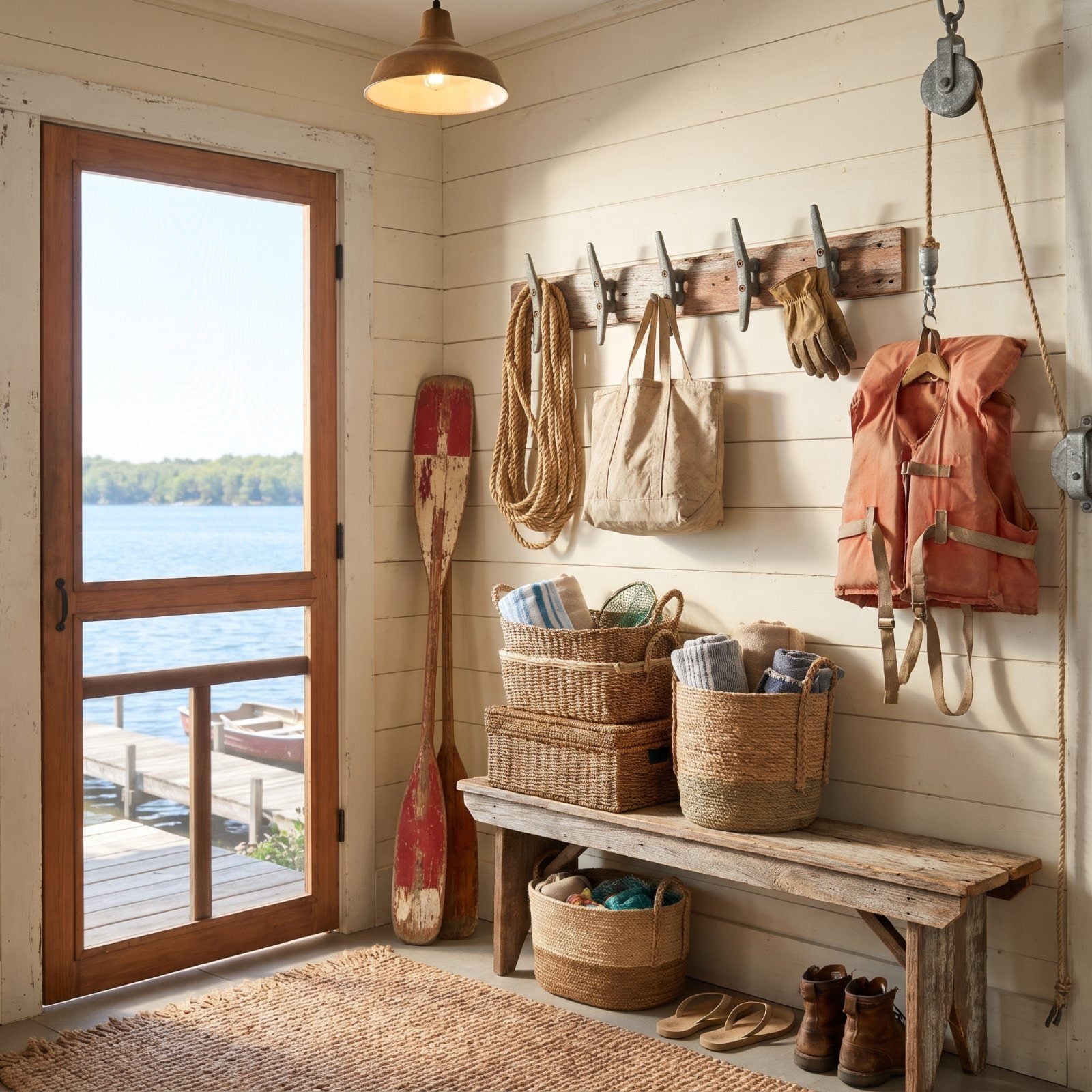
The mudroom floor tells on you. Four wet life jackets, a tangle of dock lines, flip-flops in three sizes nobody claims, and a fishing rod leaning in the corner where it will absolutely fall on someone by Tuesday. Lake houses collect gear the way a boat collects water — slowly, then all at once. The good news? The best fixes up here aren’t bought from a catalog. They’re improvised from the stuff already drifting around the dock and the garage, and these are the ones worth stealing before next summer soaks everything again.
Please note that some of the imagery in this article may have been enhanced with the assistance of AI.
44. Turn an Old Canoe Into Overhead Gear Storage
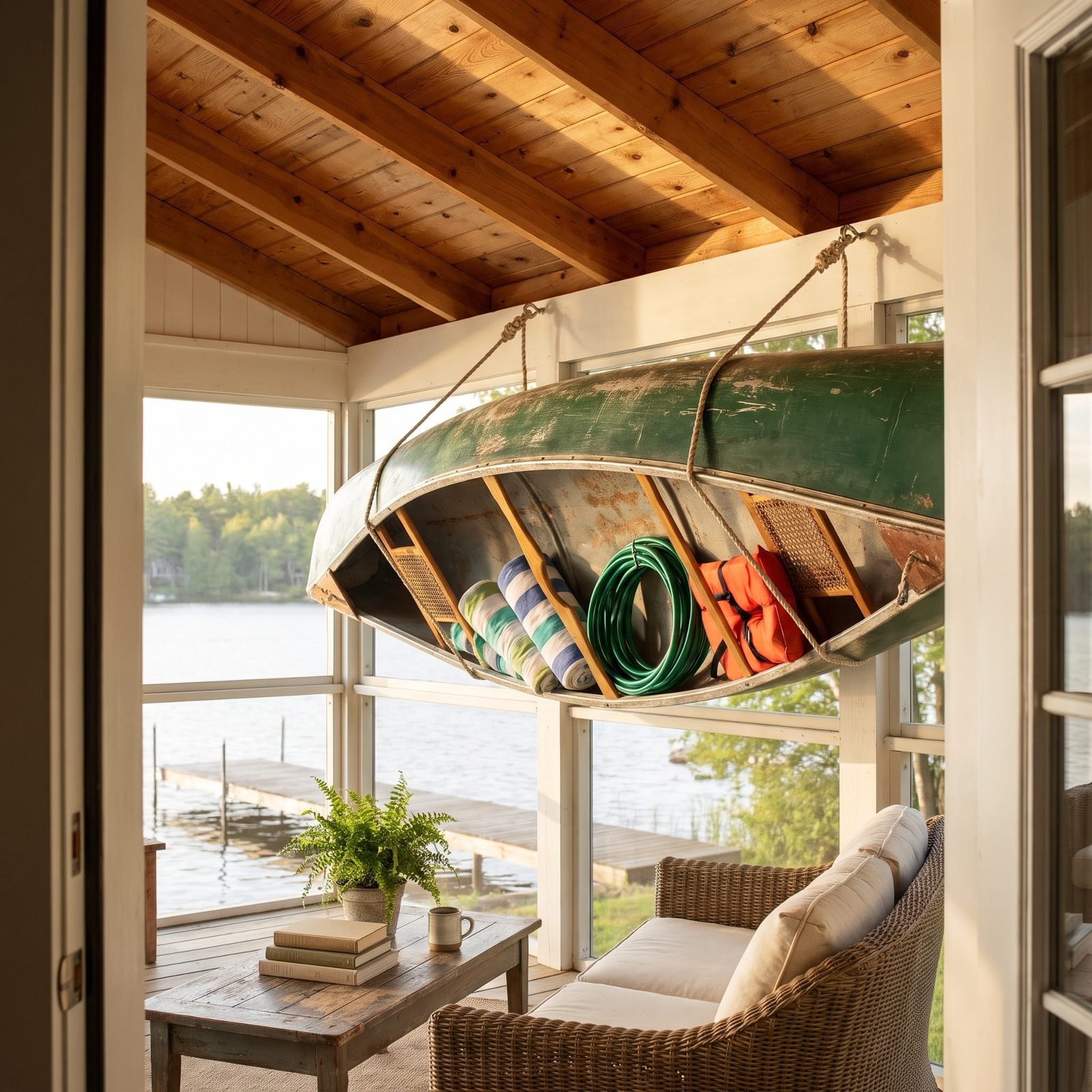
That cracked canoe nobody paddles anymore has one good trip left in it: up to the ceiling. Hung hull-down from the rafters with marine rope and a couple of eye bolts, so the open interior faces up, it becomes a long overhead cubby for rolled towels, life jackets, a coiled hose, and anything light and bulky.
Keep the load under roughly 30 pounds and spread it evenly, because a sagging canoe over your head is a bad afternoon. Skip anything you reach for daily — nobody wants a step stool as part of their morning routine.
43. Hang Life Jackets From a Ceiling-Mounted Pulley Rack
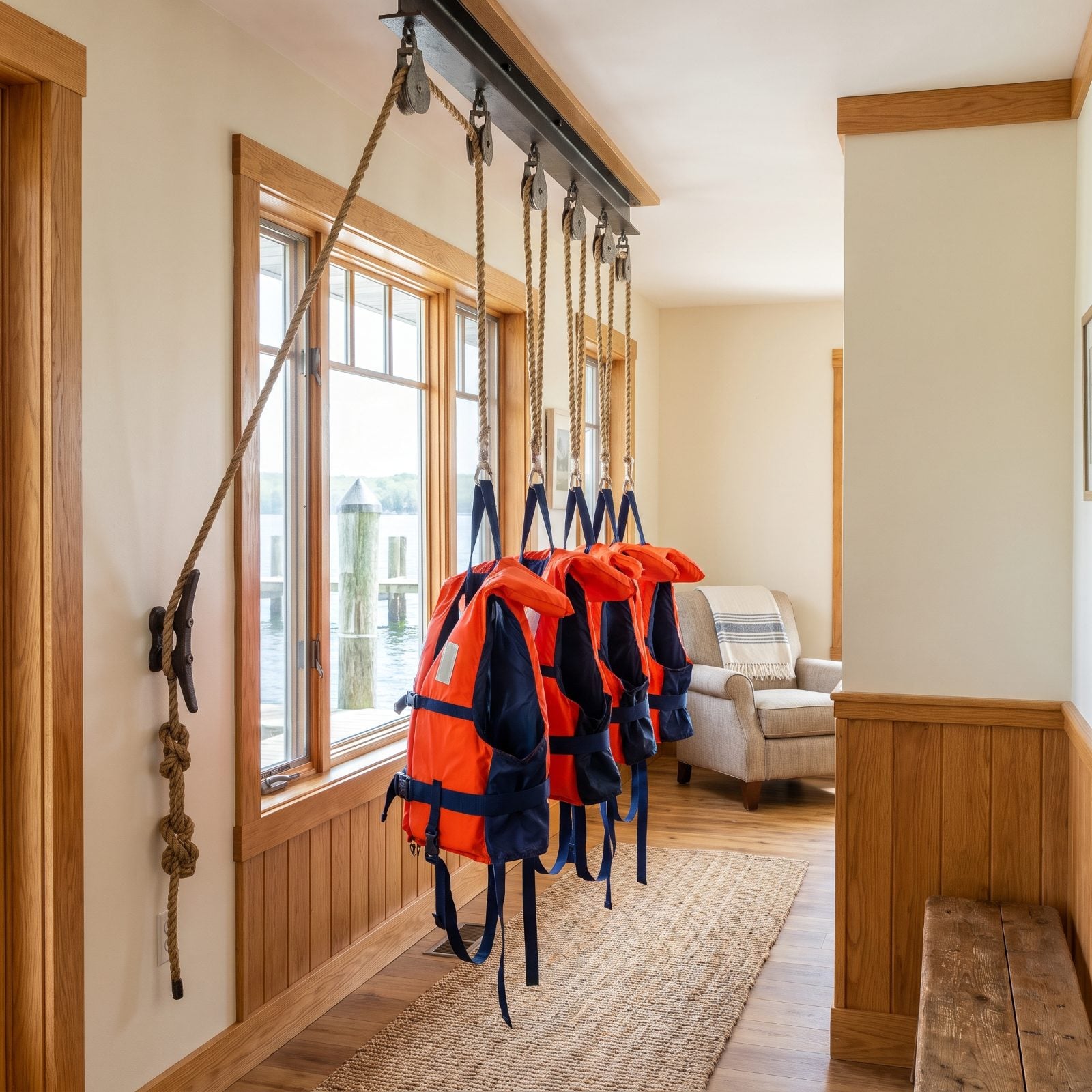
Wet life jackets dumped on the floor stay wet. Stacked in a bin, they mildew and smell like a locker that lost a bet. A pulley rack hung from ceiling hooks solves both.
Hang each vest by its top loop from a rope under the rack, so the whole row hangs at chest height down the middle of the hall, straps dangling nearly to the rug, with the rope tied off on a wall cleat. Spaced apart, they drip dry instead of onto one another. Haul on the rope to raise the whole row up near the ceiling, out of the walking space nobody ever has enough of in a lake house entry, then lower it when the kids need their gear.
42. Use Dock Cleats as Rustic Wall Hooks
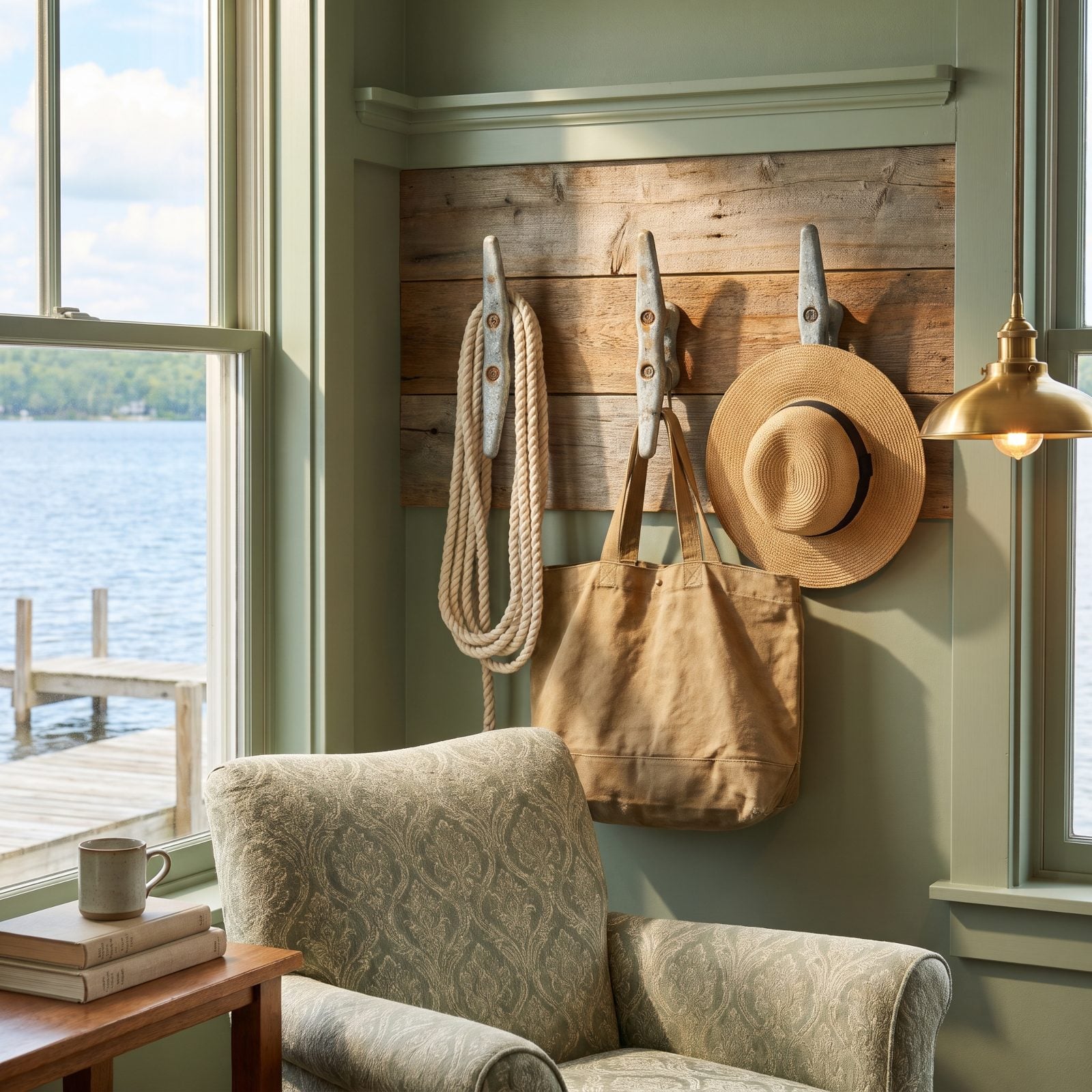
A dock cleat is already built to take a yank from a moving boat. Mounted to a wall, it shrugs off wet coats, dripping rope, and a tote full of sunscreen without complaint.
Buy them galvanized or stainless so the lake air doesn’t rust them in a season. Two screws each, spaced along a cedar board, and you’ve got hooks that look like they grew there. They beat anything from the hardware aisle, and they tell the right kind of story the second someone walks in.
41. Slide Fishing Rods Into Pool Noodles
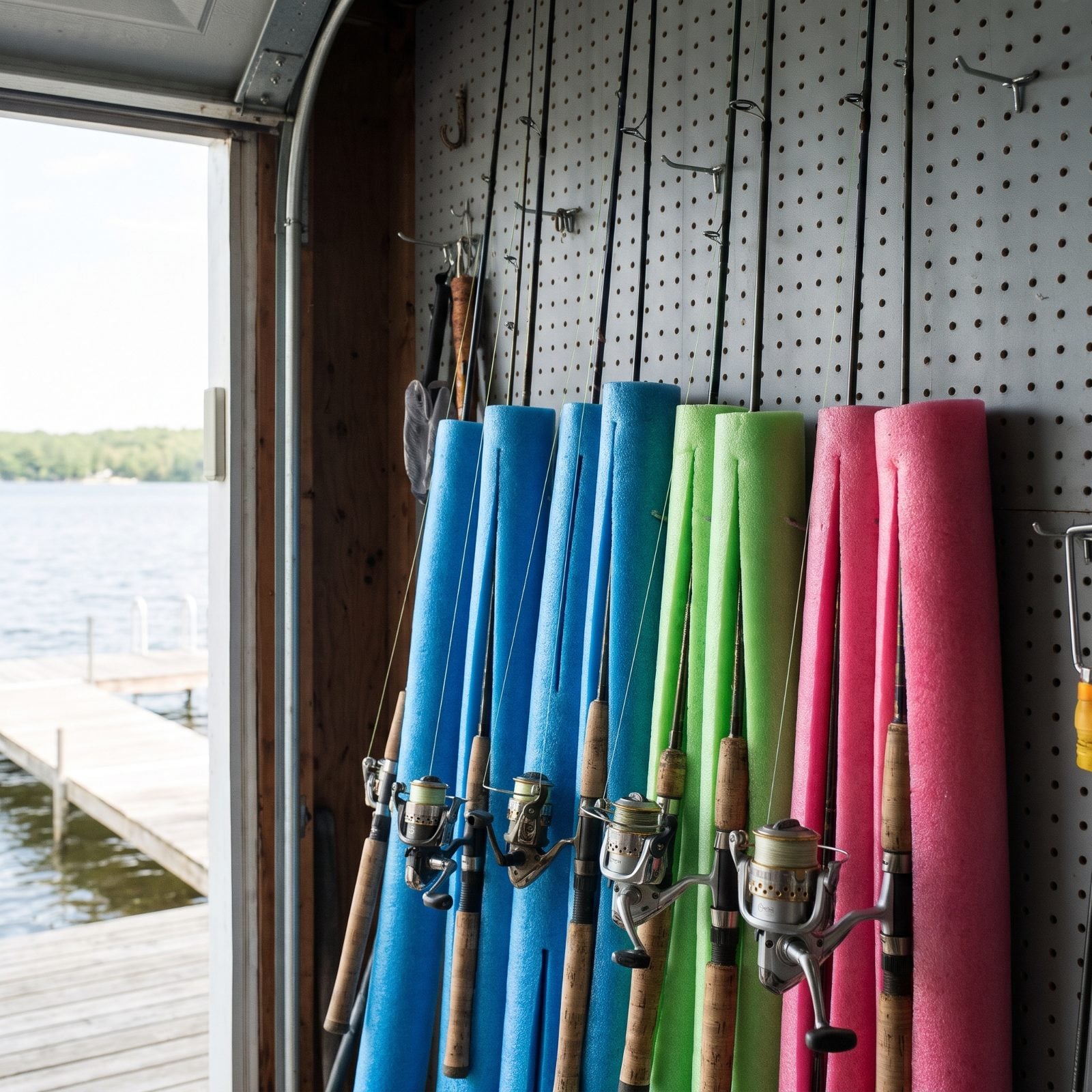
Tangled rods are the real enemy. Line catches on line, tips snap in doorways, and you burn the first hour of a fishing morning untying a bird’s nest instead of casting.
Cut a pool noodle into long sections, slice a slit down each piece, and press two or three rods into each one around the middle of the blanks. Now they stand in a corner like a quiver — spaced apart, blanks cushioned, line separated. Cheap, soft, and it floats if it ever goes overboard.
40. Strap Kayak Paddles Beneath Open Shelves
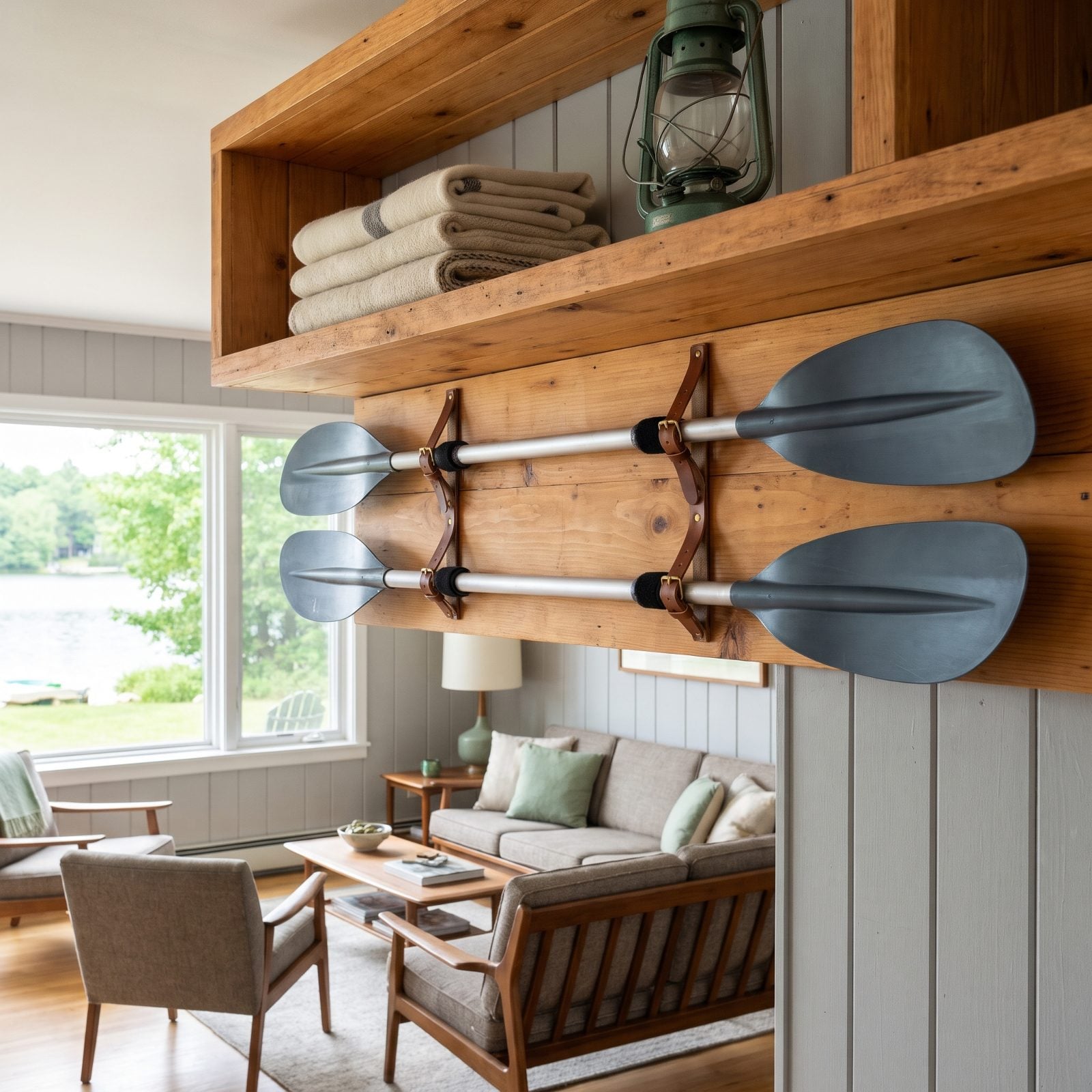
The wall just below an open shelf is dead space. Paddles are long, flat, and awkward everywhere else. Put them together.
Two vertical straps screwed into a wood backer board on the wall cradle paddles horizontally, on display and off the floor. It frees up the corner where paddles usually lean, slide, and crash down at midnight. Works for a spare oar or a boat hook too.
39. Mount a Magnetic Strip for Fishing Tools
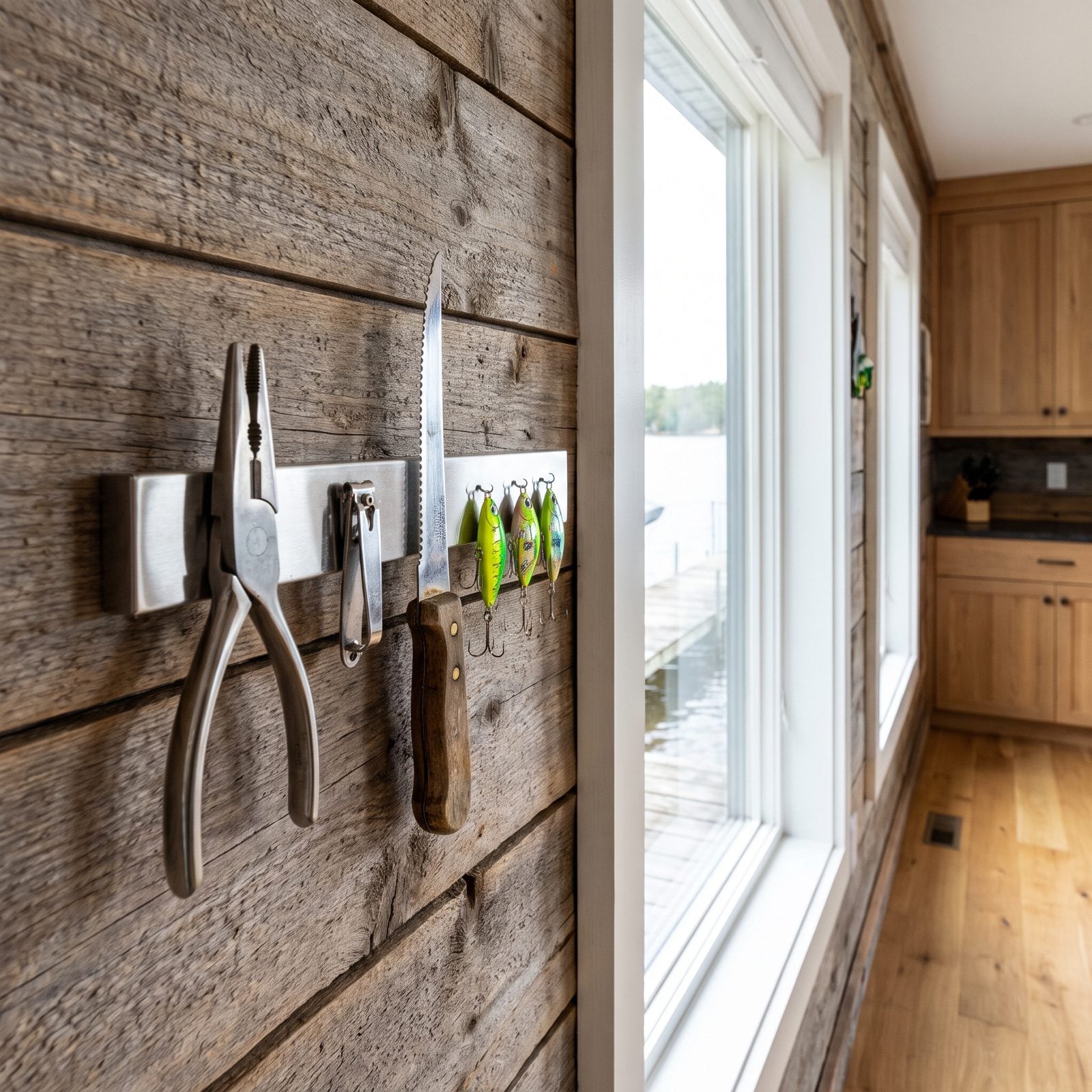
Fishing tools scatter. Pliers end up in the boat, clippers fall behind the bait fridge, and the filet knife hides until it finds a finger instead.
A magnetic knife strip — the kitchen kind — puts every metal tool on the wall where you can see it. Slap it up near your cleaning station. Pliers, clippers, hook removers, even a few spare lures stick right there, dry and visible. You grab what you need without rummaging, and nothing rusts in a soggy drawer.
38. Hide Spare Dock Lines Inside a Lidded Buoy Basket
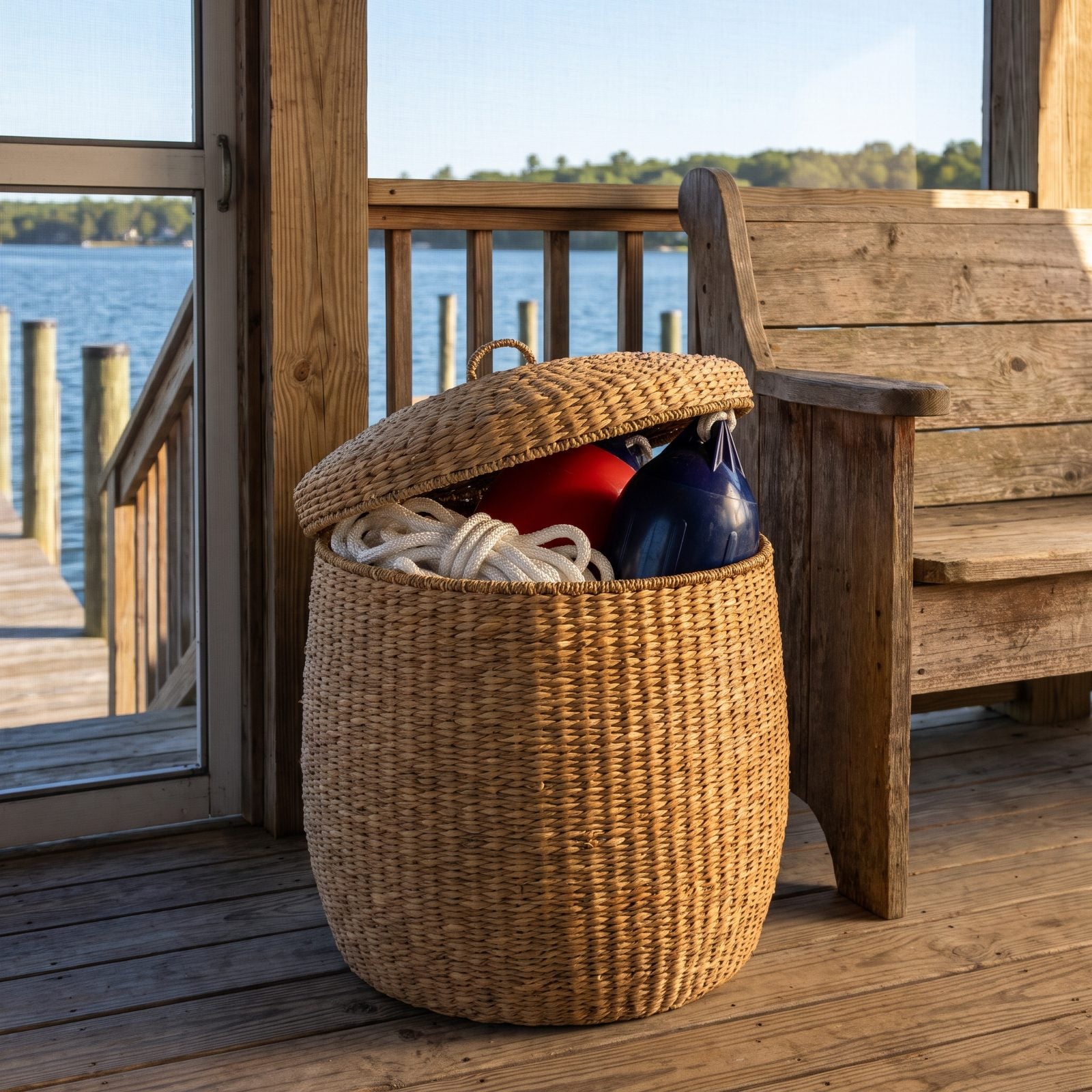
Spare dock lines look like clutter the second they’re out of the water. Coiled in a corner, they trip people and collect spiders.
A big lidded seagrass basket swallows them whole and passes for decor instead of rigging. Toss in the extra fenders while you’re at it. Lid down, it’s a side table. Lid up, it’s your line locker — right by the door where you actually need it when a storm blows in and you want a second tie-off fast.
37. Clip Wet Gloves to a Retractable Laundry Line
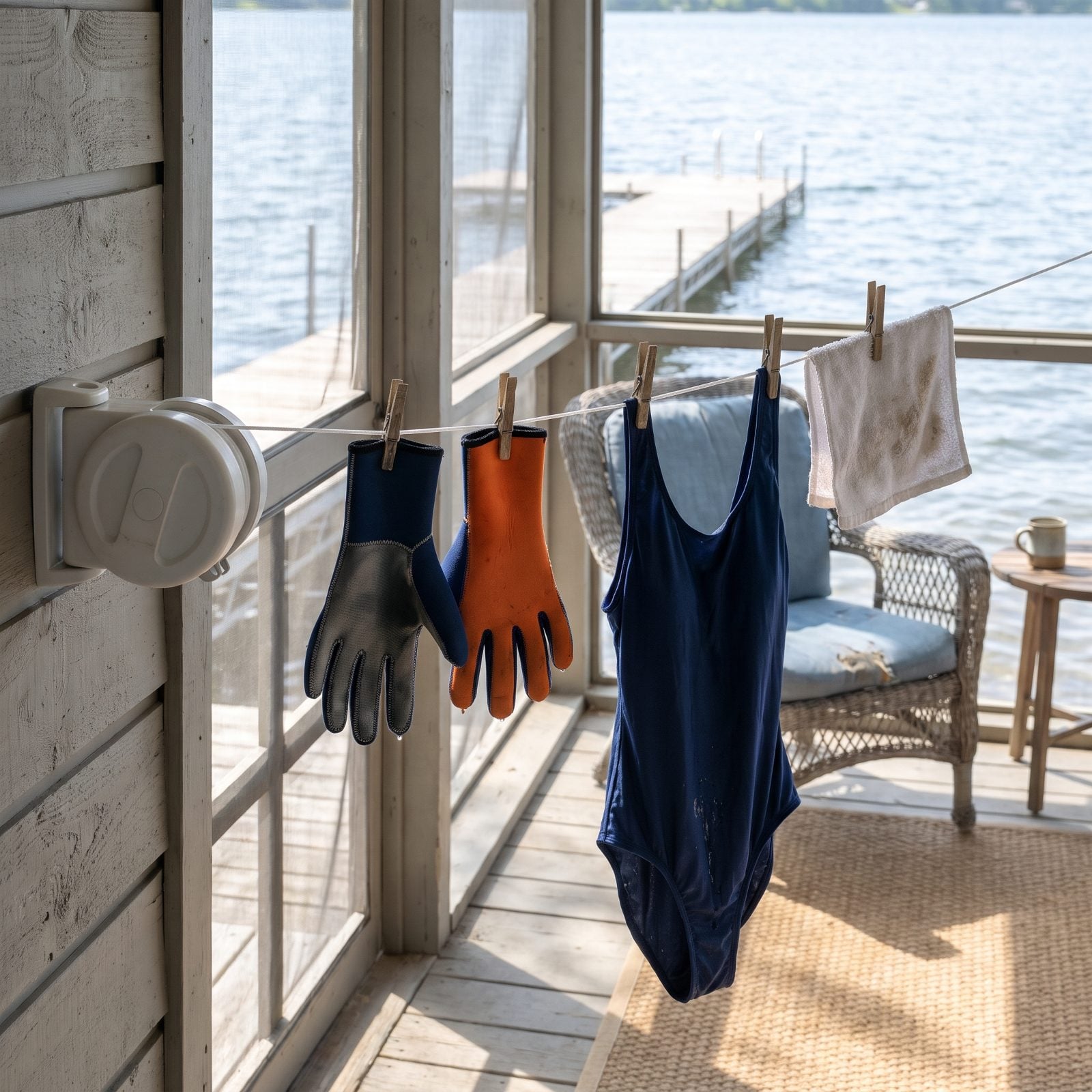
Neoprene gloves balled up in a pocket stay damp for days and start to stink. Laid flat, they take forever and hog counter space.
A retractable laundry line mounted on a screened porch pulls out when you need it and disappears when you don’t. Clip the gloves by the cuff, add a wet swimsuit or a hand towel, and the breeze off the water does the rest. Reel it back in and the porch looks empty again.
36. Corral Flip-Flops in a Repurposed Magazine Rack
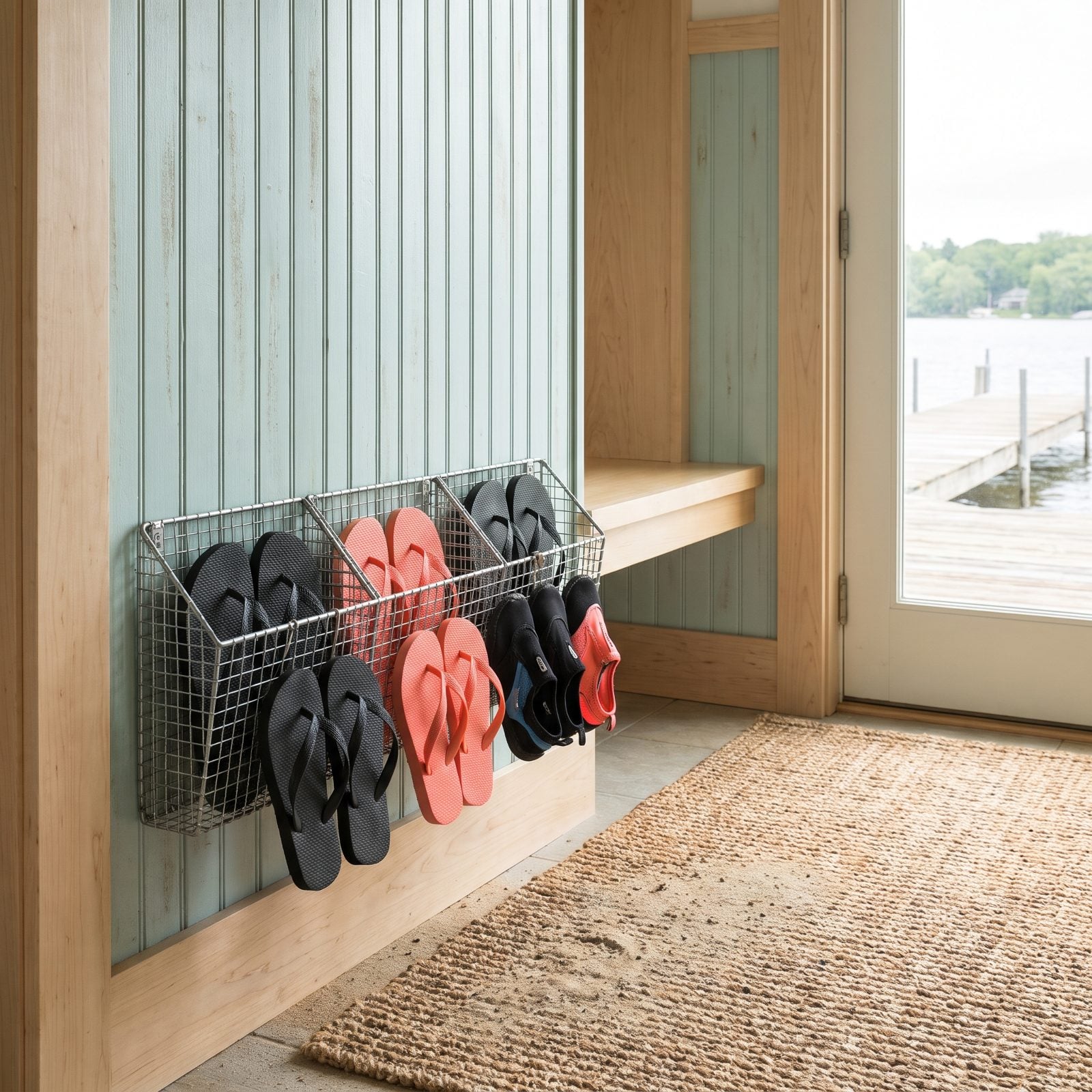
Flip-flops breed. Four people arrive and somehow eleven pairs end up by the door, all single, none matching, every one of them underfoot.
A wall-mounted wire magazine rack flips the problem sideways. Pairs slip upright into its three wire pockets or line up along its front, sand falling to a mat below instead of into your socks. Everyone grabs their own, nobody steps on a buckle in the dark, and the floor stays clear enough to actually walk across.
35. Stand Pool Noodles in a Tall Laundry Hamper
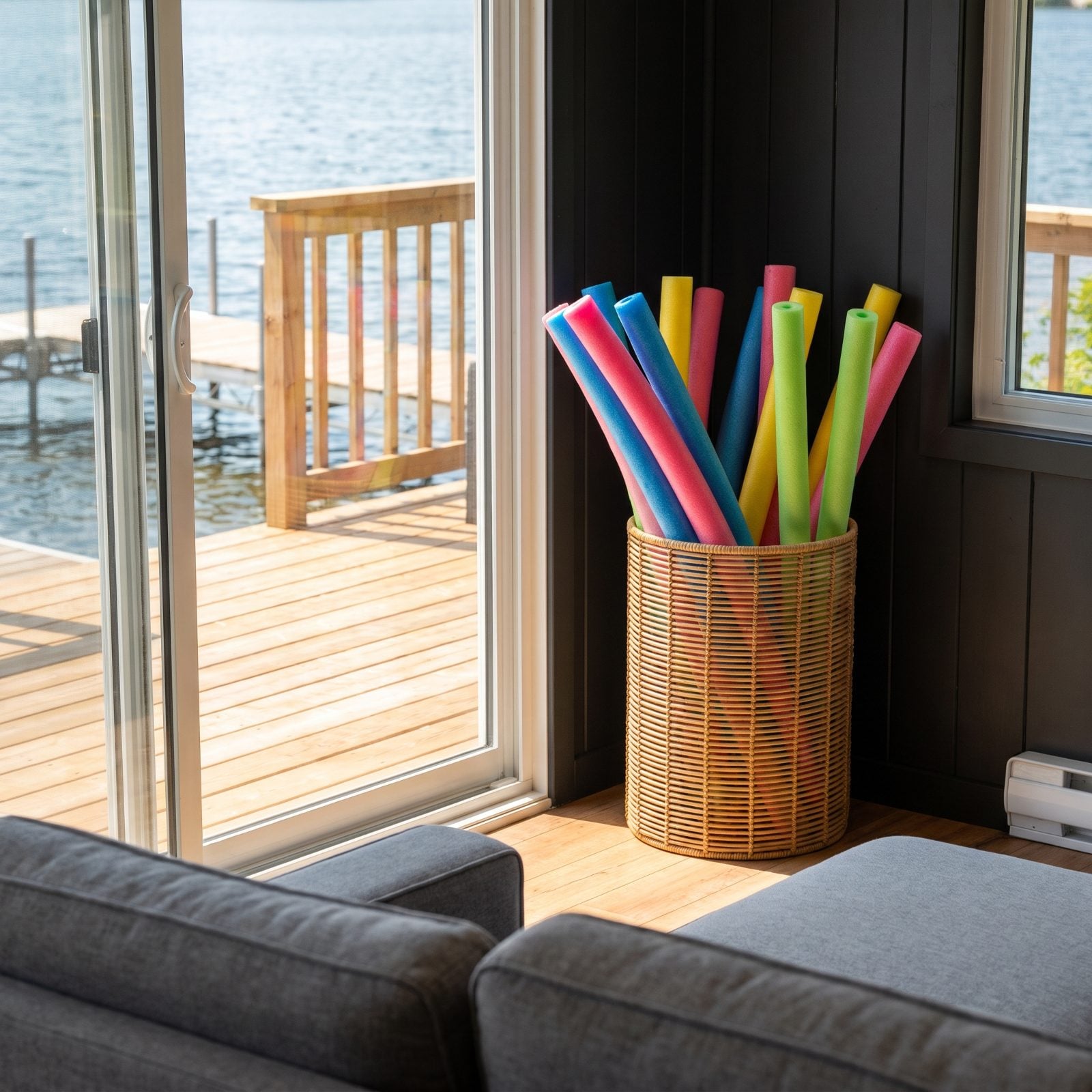
Pool noodles are the worst-shaped thing to store at a lake. Too long for a bin, too floppy for a shelf, always sliding off wherever you lean them.
Stand them up in a tall woven laundry hamper and the problem vanishes. They slot in vertically like a loud foam bouquet, drain through the woven sides, and the hamper hauls the whole lot down to the dock in one trip. Leave it out on the deck and it turns into a bright corner the kids can raid themselves.
34. Hang Inner Tubes From Oversized Carabiners
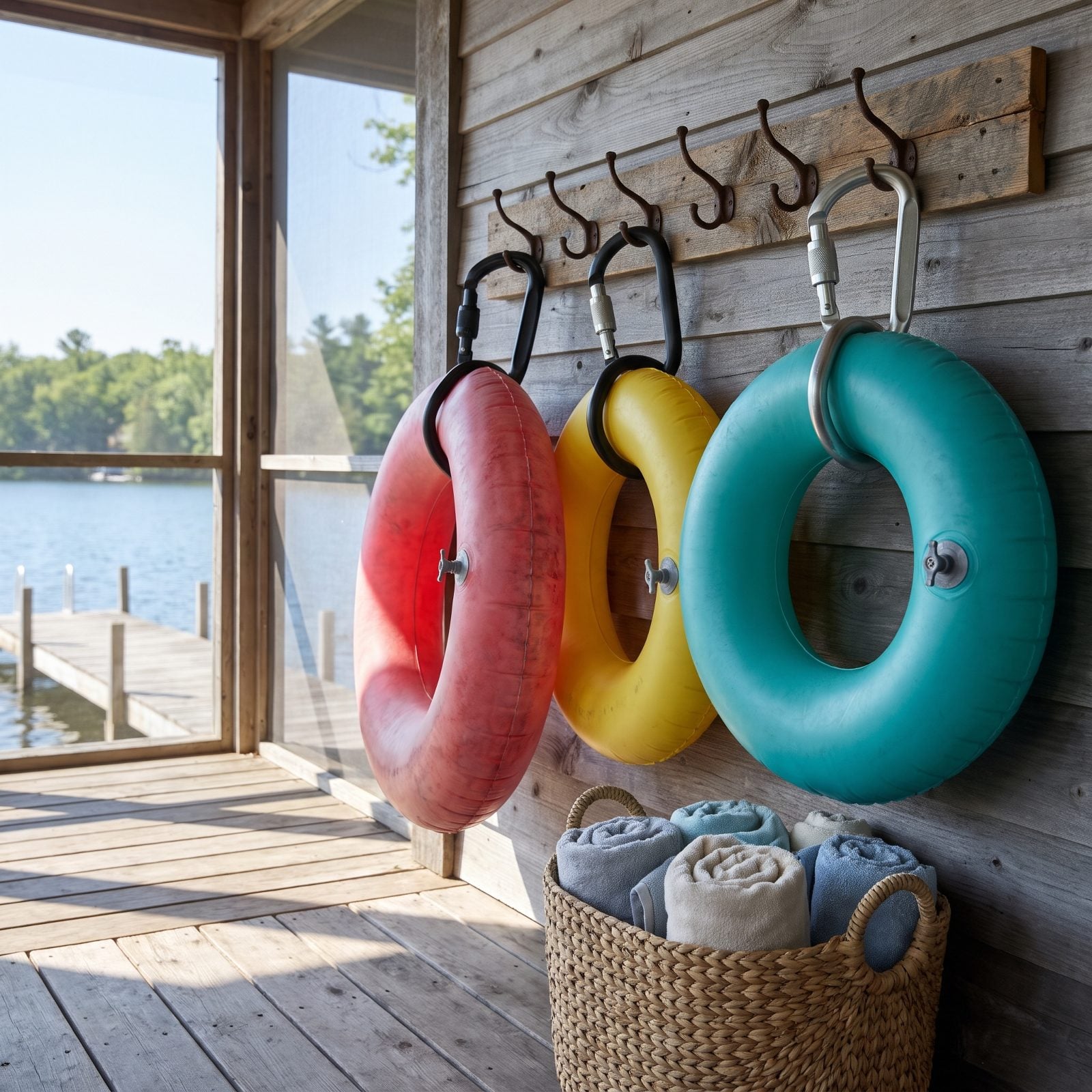
Inner tubes are the worst thing you own. They’re floppy, heavy when damp, and impossible to stack without rolling off into a corner where they grow a smell by August. The fix costs about six dollars.
Clip an oversized carabiner through the tube’s valve stem or grab handle, then hook it to a rail, a joist, or a line of coat hooks on the porch wall. The tube hangs flat, drips dry, and comes down with one tug when the kids want the water.
Go big here: oversized gate-style carabiners are easy to work with wet hands.
33. Store Inflatable Floats in Mesh Produce Bags
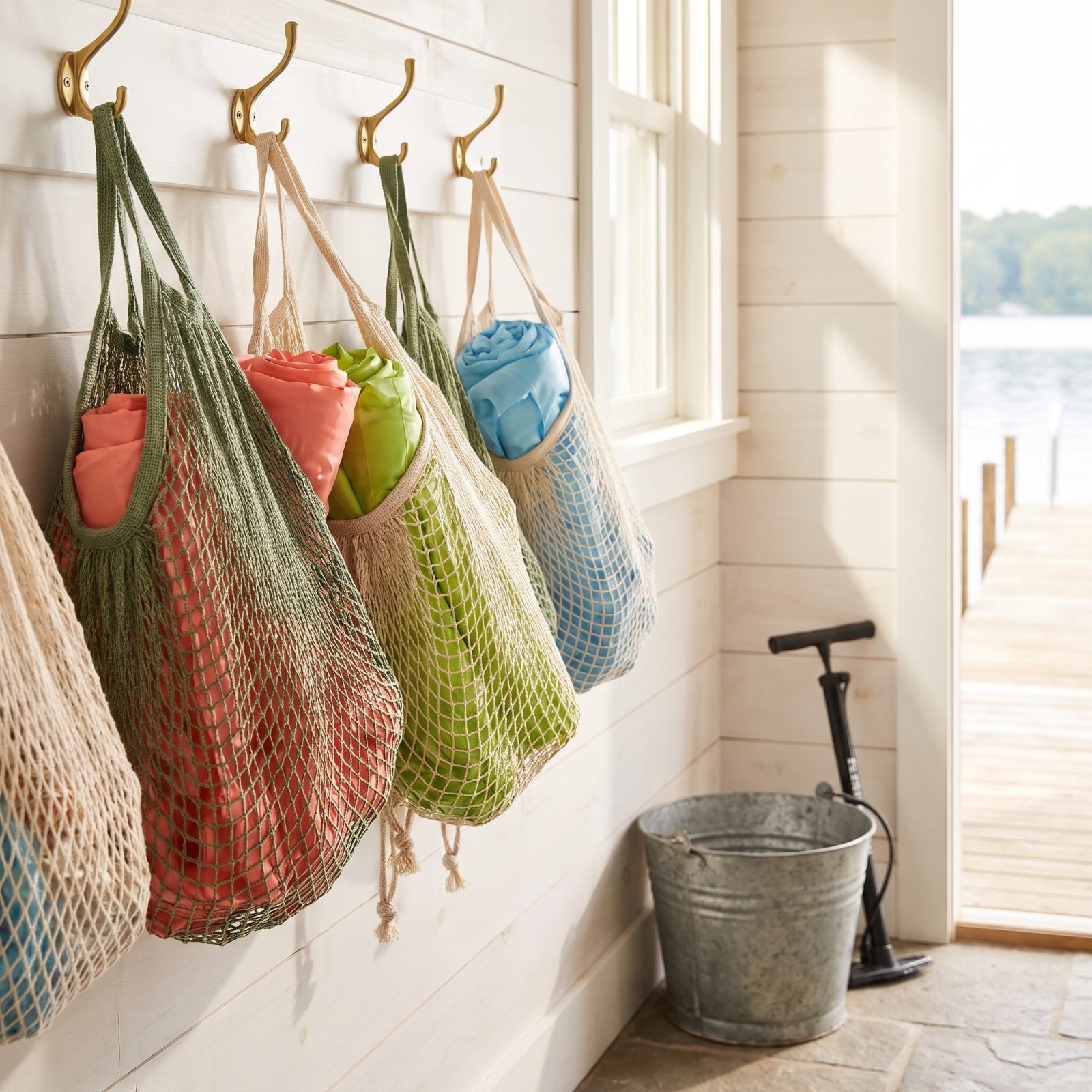
Deflated floats hold water in every crease. Shove them in a plastic bin and you’re growing mildew by the weekend.
The big drawstring mesh produce bags let air move through while keeping a whole flamingo and two loungers in one bundle. Hang one on a hook and it drains, breathes, and stays off the floor. Bonus: you can see what’s inside without digging.
32. Suspend Beach Towels From an Old Wooden Ladder
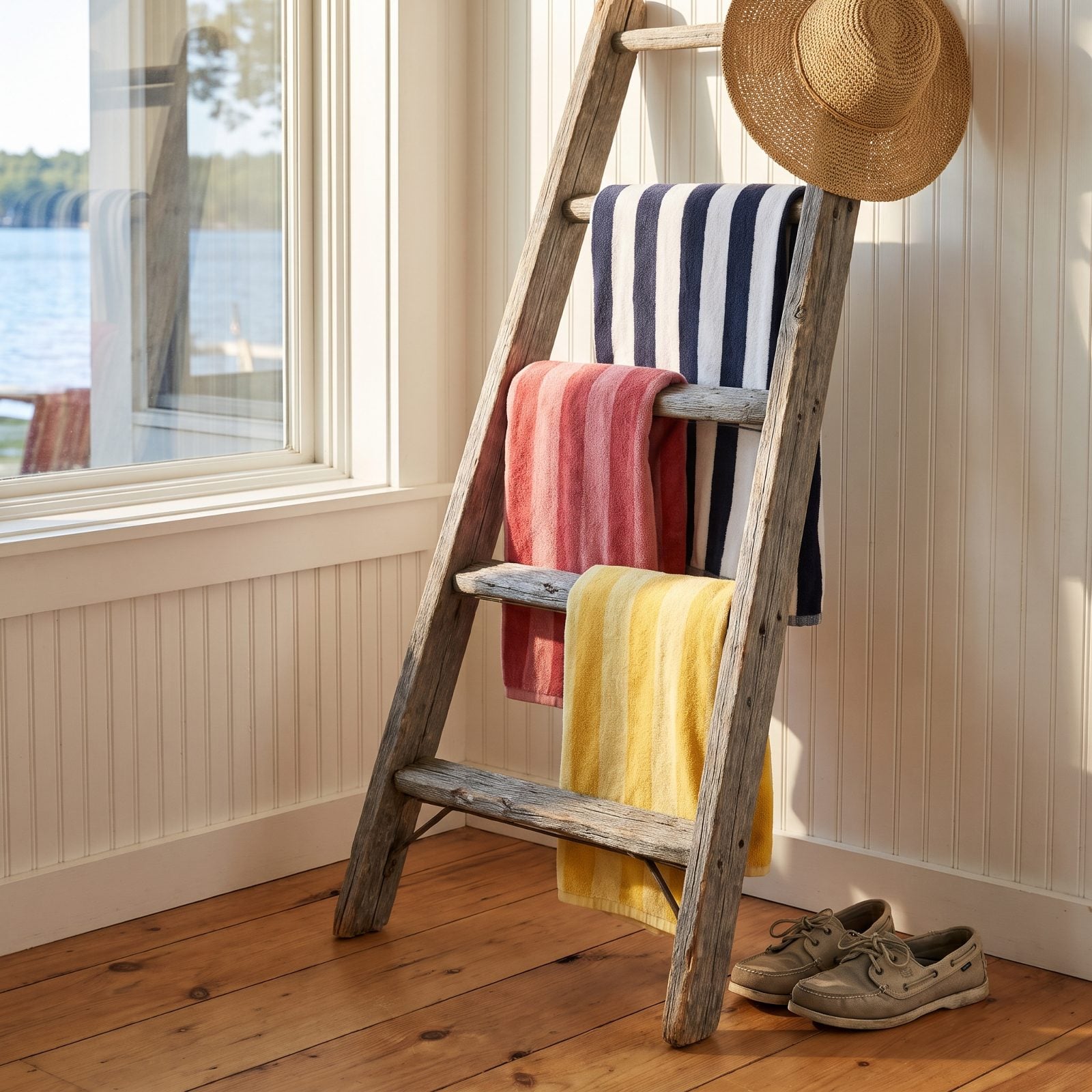
An old wooden ladder leaned against a wall does more than any towel bar ever will. Each rung holds a full beach towel draped loosely over it, so it gets air instead of souring in a damp wad on the floor.
Thrift-store orchard ladders run cheap and already have the look you want: gray, cracked, honest. Sand off any splinters and leave the patina alone. A rung for each towel, the top one for your sun hat, zero wall hooks to drill. Prop it beside a doorway and grab a towel on your way out.
31. Tuck Sunscreen Into a Hanging Shoe Organizer
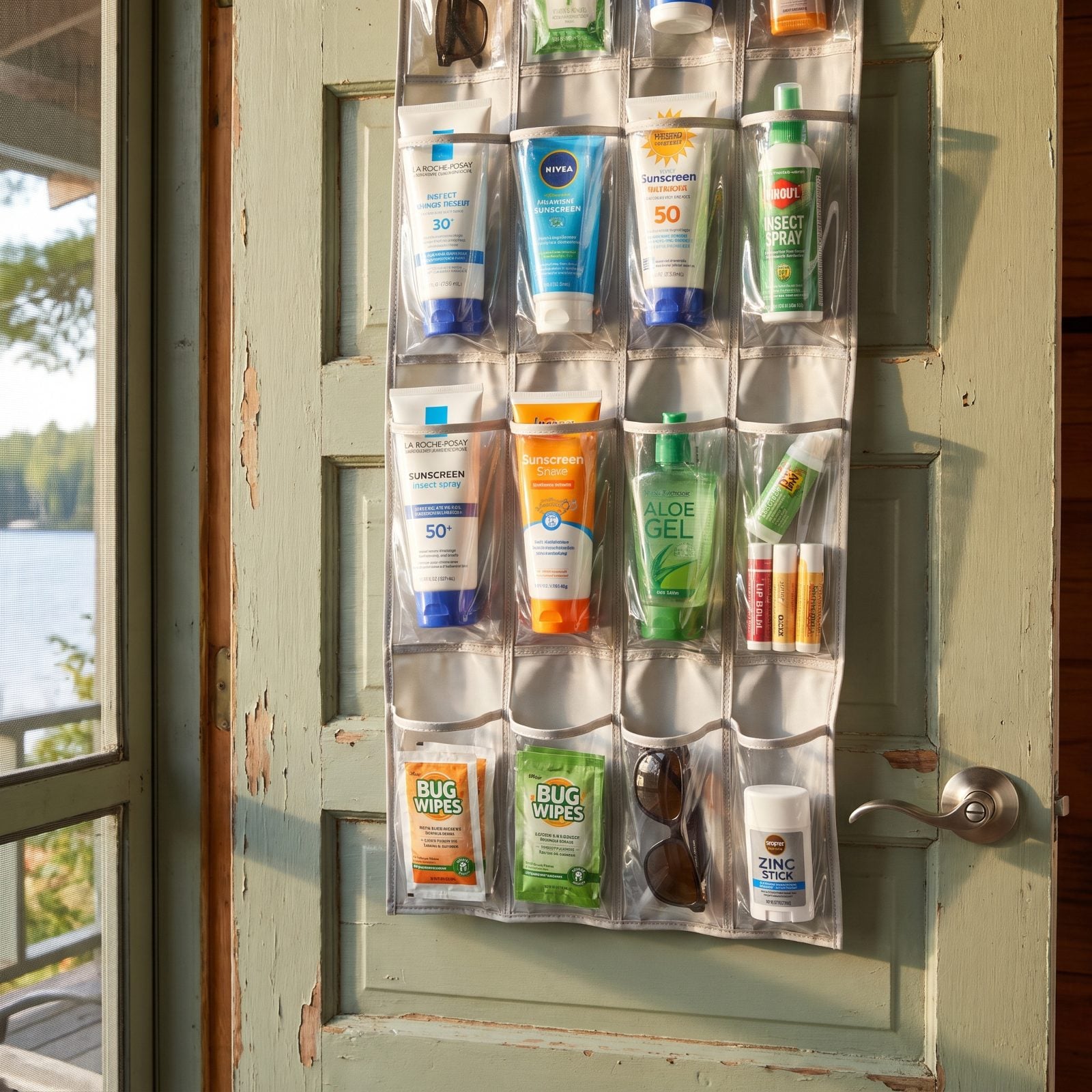
You know the drawer. The one where seven half-empty sunscreen tubes go to die, lids crusted shut, next to a melted bug spray and somebody’s single flip-flop.
A clear-pocket shoe organizer on the back of the mudroom door fixes the whole mess. One pocket per thing: SPF 50 here, aloe there, bug wipes, lip balm, the polarized sunglasses nobody can ever find. You see everything at once and grab it on the way out the door.
Cheapest upgrade on this list, and the one your guests will quietly thank you for.
30. Turn a Galvanized Drink Tub Into a Wet-Gear Bin
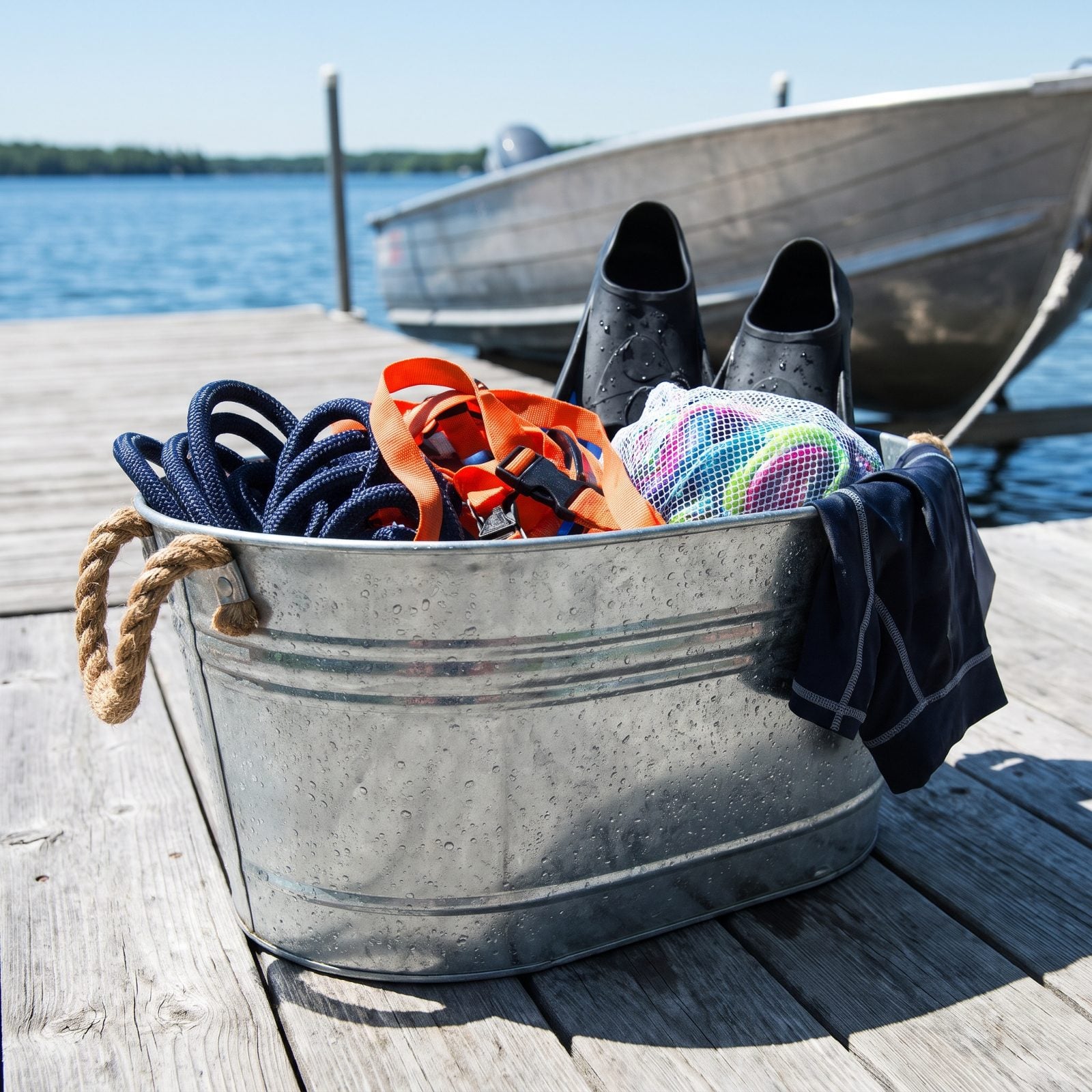
A galvanized party tub is a wet-gear bin that doesn’t know it yet.
The zinc shrugs off water, the open top lets things air out, and the rope handles mean you can haul the whole soggy pile from dock to porch in one trip. Life jackets, fins, dripping rash guards, tangled dock lines — all of it goes in wet and nobody cares.
Drill a few drain holes in the bottom if you want it to shed water on its own. Otherwise tip it to pour off the puddle. These things live for decades outdoors, which is more than you can say for a plastic bin that needs replacing every summer.
29. Line Mudroom Baskets With Removable Mesh Bags
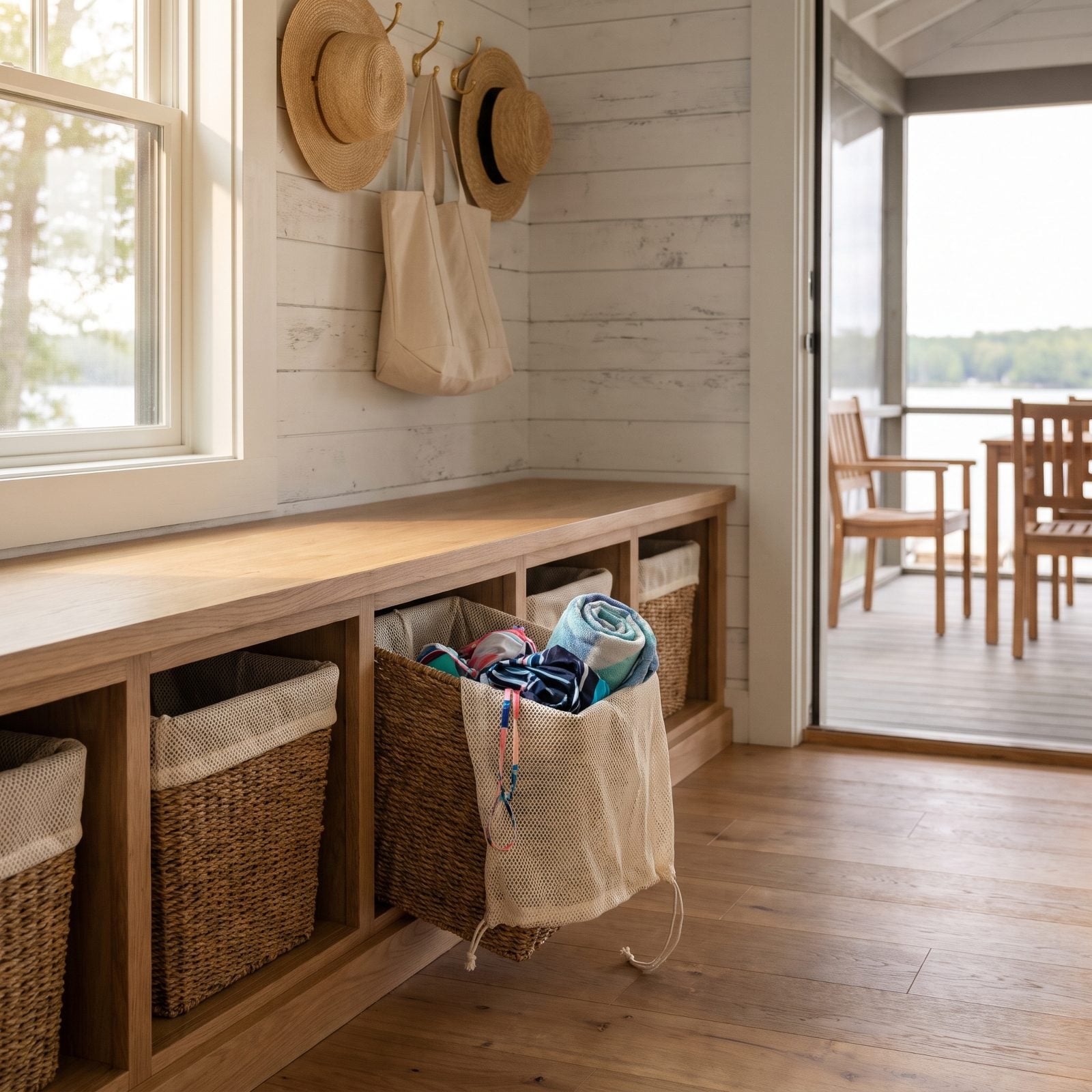
Woven baskets look great in a mudroom and rot from the inside the second you drop wet swimsuits in them. Water pools at the bottom, the seagrass stays damp, and six weeks later the whole thing smells like a pond.
Set a fine-mesh drawstring laundry bag inside the basket as a liner. Wet gear goes in the mesh, water drains through, and when it’s time to dry everything you lift the whole bag off and hang it. Basket stays dry and keeps its good looks.
28. Fit Toe-Kick Drawers Beneath Kitchen Cabinets
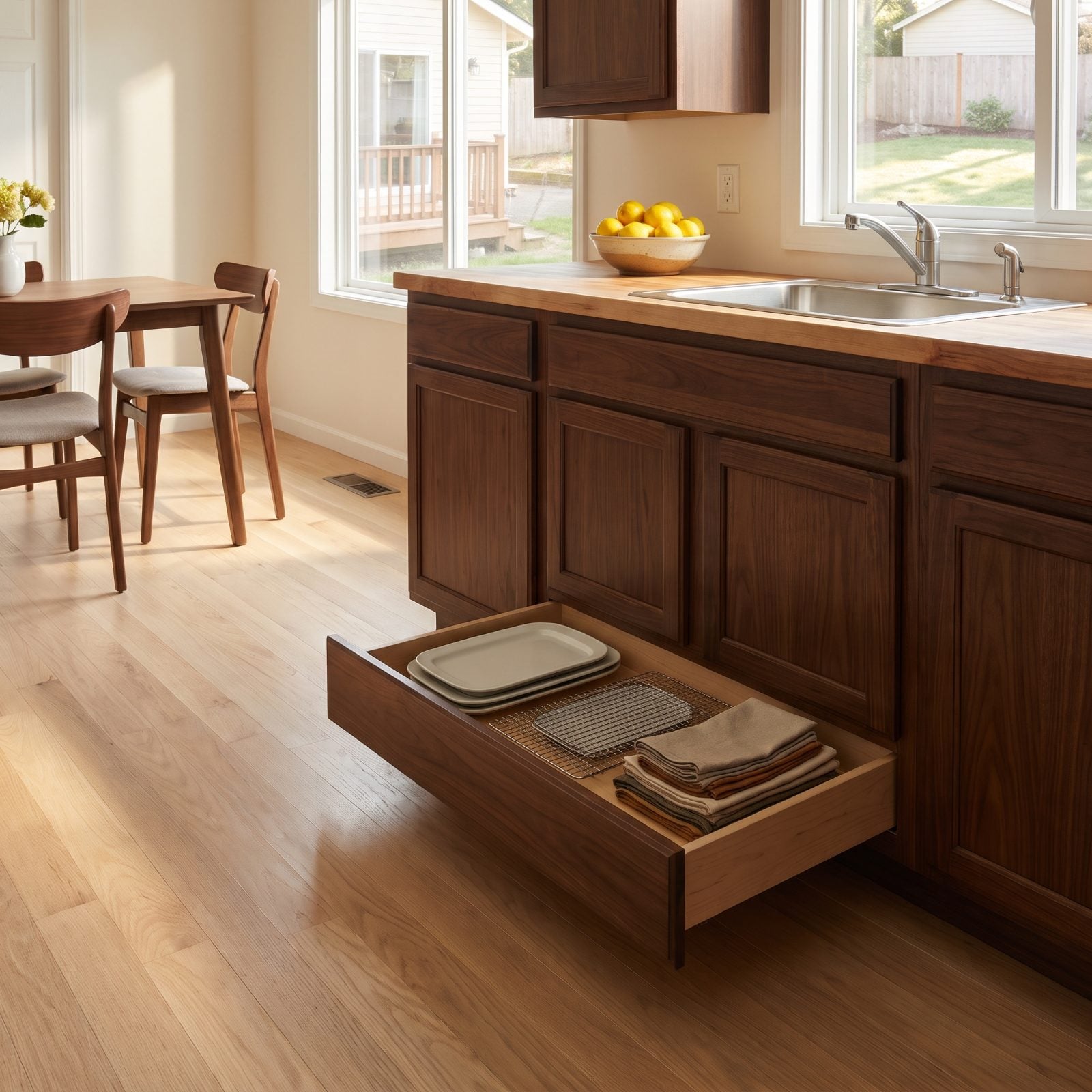
That low zone at the base of your lower cabinets, right down by the floor, is too often just dead space. In a cabin kitchen where every inch matters, you’re wasting real estate.
Deep, floor-level drawers fit right into that space and swallow all the flat, awkward stuff: serving platters, cooling racks, placemats, the big cutting boards. They blend in with the cabinet fronts when closed, and you nudge them open with your foot when your hands are full of a potato salad bound for the dock.
27. Use Vintage Suitcases as Bedside Storage
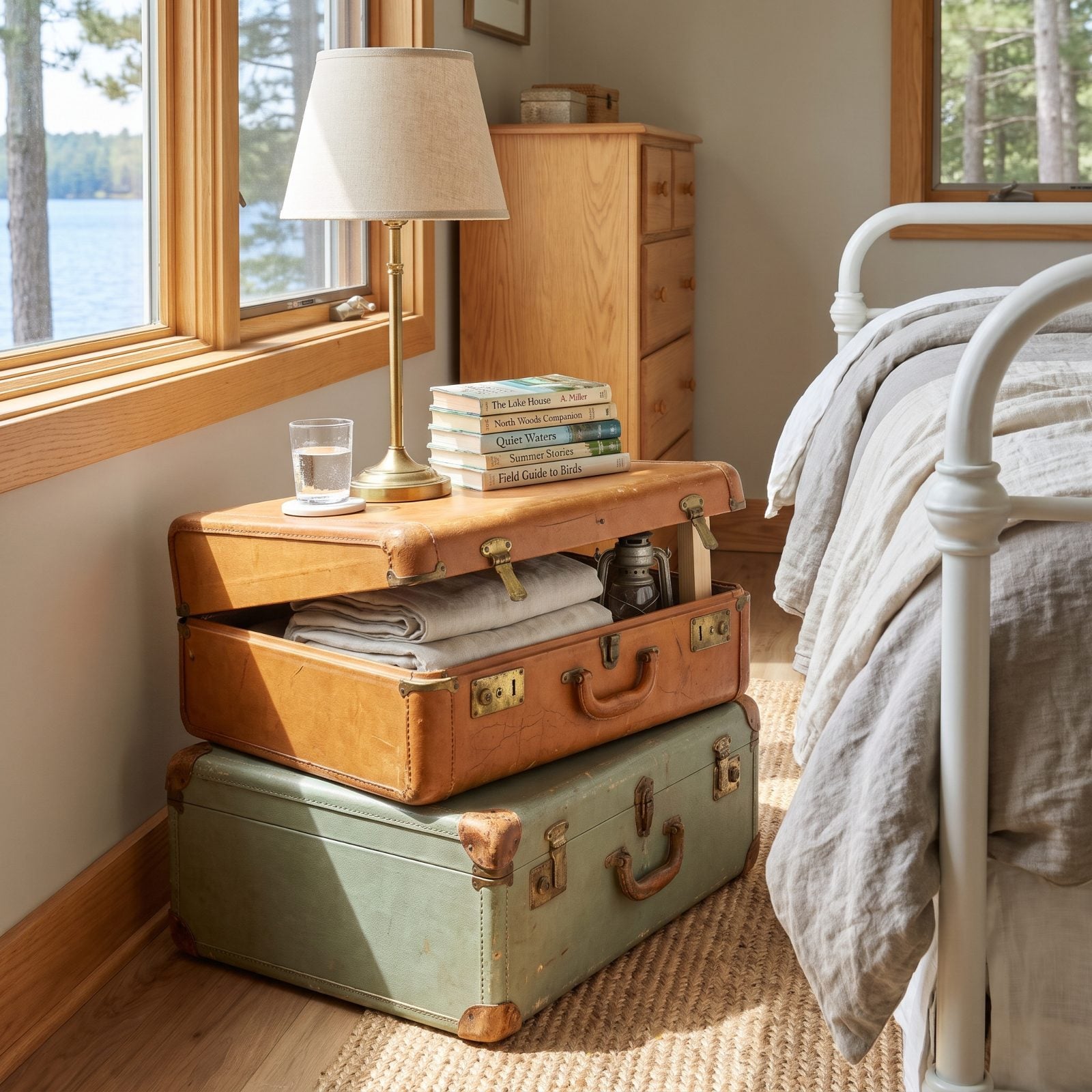
Stack two old hard-shell suitcases and you’ve got a nightstand that doubles as hidden storage. The top one holds the lamp and your book. Inside, out of sight, go the spare sheets, the extra lantern, the stuff you want near the bed but not on display.
Hunt for them at estate sales and flea markets. The leather-trimmed ones with brass latches run anywhere from ten to fifty bucks, and they look like they’ve already spent a few summers at the lake. Which is exactly the point.
26. Turn Wooden Crates Into Rolling Under-Bed Drawers
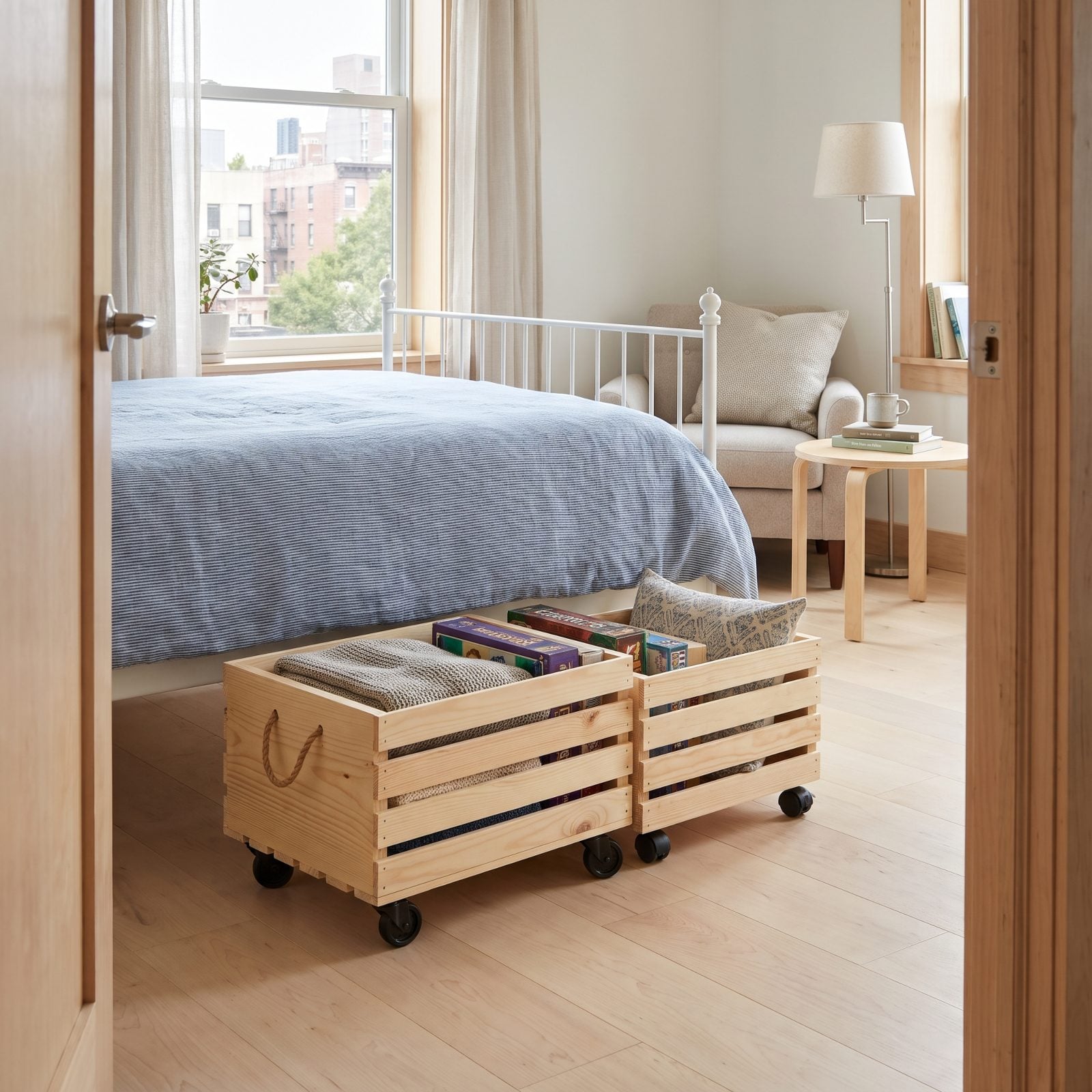
Screw four casters to the bottom of a wooden crate and the empty floor under the bed finally earns its keep.
Each crate rolls out on its wheels, holds extra blankets or off-season gear or the board games nobody wants cluttering a shelf, and rolls back into place, tucked neatly out of sight under the bed. In a cabin where closets are a luxury, under-bed square footage is the quiet MVP.
Use swivel casters, not fixed ones. Fixed wheels fight you every time the crate catches a floorboard seam. We learned that the hard way.
25. Hang Extra Blankets From Leather Blanket Straps
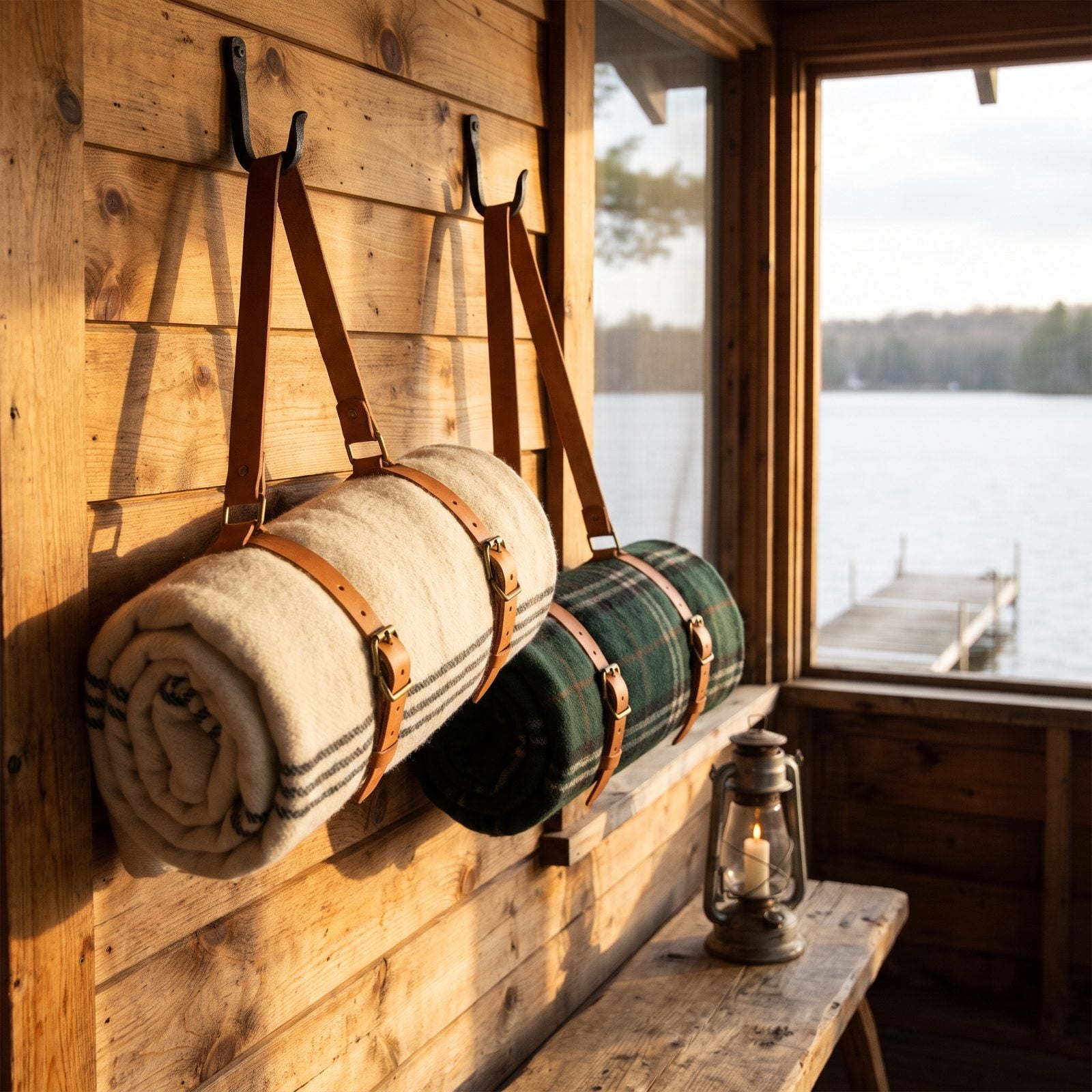
Folded blankets in a closet are blankets nobody reaches for. Roll them tight, cinch a leather carrier strap around each one, and hang them from a wall hook where everyone can see and grab them.
The strap keeps the roll from flopping open and the wool gets to breathe instead of going musty in a dark cupboard. On a screened porch in late September, when the evening turns cold and the lake goes still, you want that stack of blankets right there on the wall — not two rooms away.
24. Fold Guest Linens Into Their Matching Pillowcases
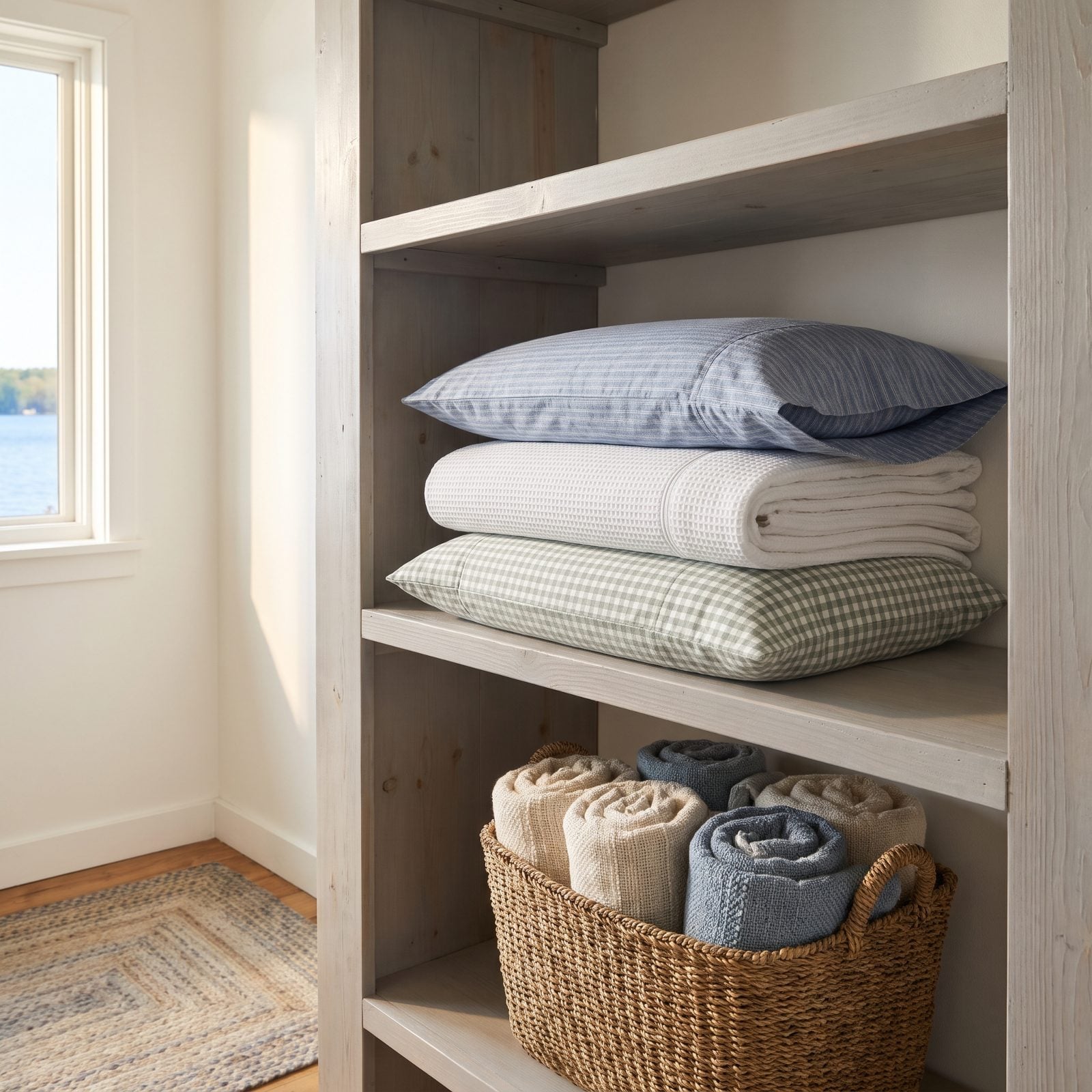
Nothing eats a lake house closet faster than loose sheets. One set unravels, you tug the fitted sheet, and the whole shelf comes down like a sandcastle at high tide.
Here’s the fix. Fold the flat sheet and fitted sheet, stack them with a single pillowcase, then slide the whole bundle inside the second matching pillowcase. Each bed’s set becomes one tidy square, so guests grab a packet instead of a puzzle and you stop finding orphaned fitted sheets balled up in the back corner three summers later.
23. Use a Hanging Fruit Basket for Rolled Washcloths
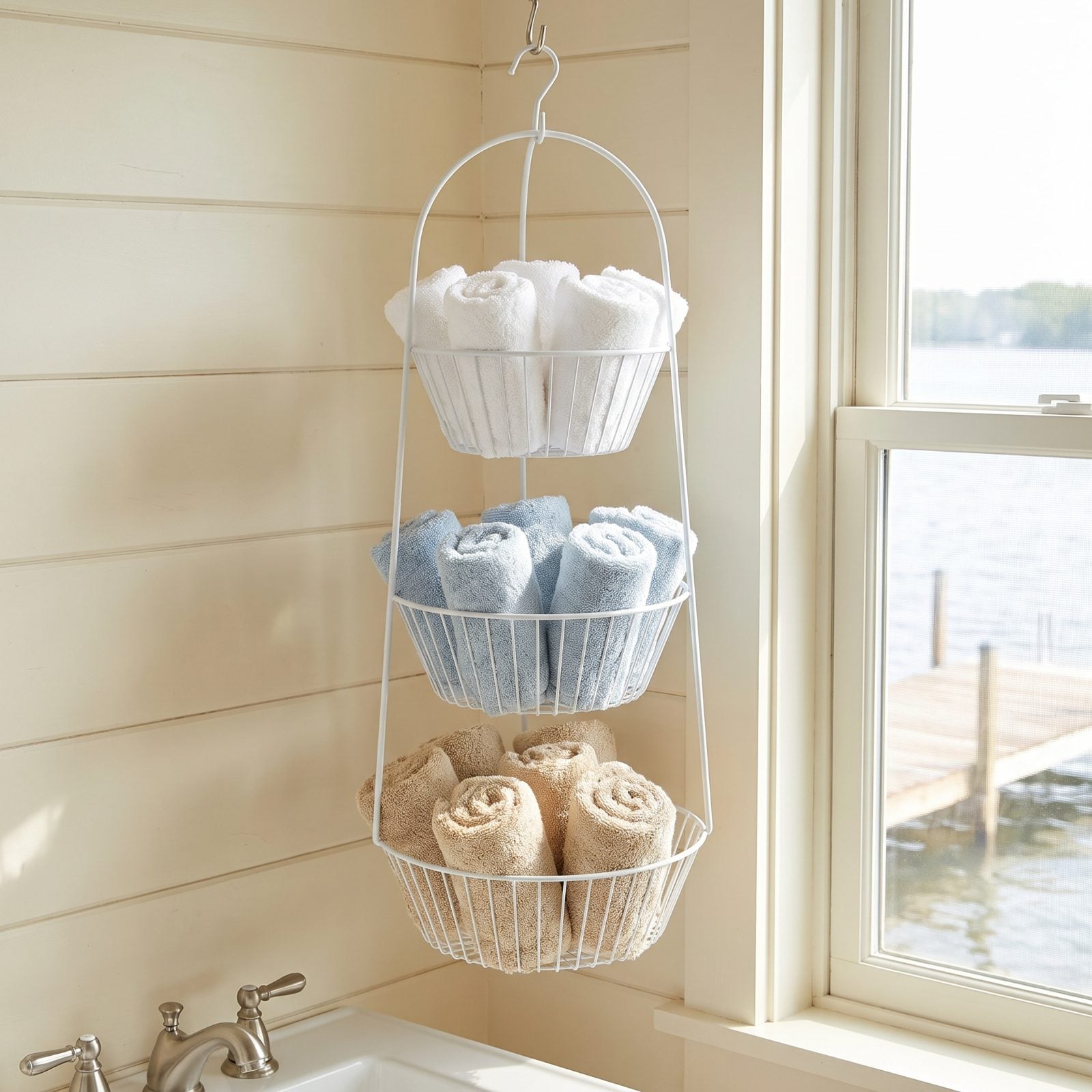
Counter space in a lake bathroom runs about four inches wide and already holds a toothbrush cup and somebody’s sunscreen. So go up, not out.
A hanging three-tier fruit basket, the kind meant for onions and bananas, cradles rolled washcloths like little loaves. The open wire lets them dry between swims, which matters when six wet kids cycle through before lunch, and the whole thing costs a few bucks while freeing the counter entirely. It looks almost too clever, until you use it.
22. Mount Mason Jars Beneath Bathroom Shelves
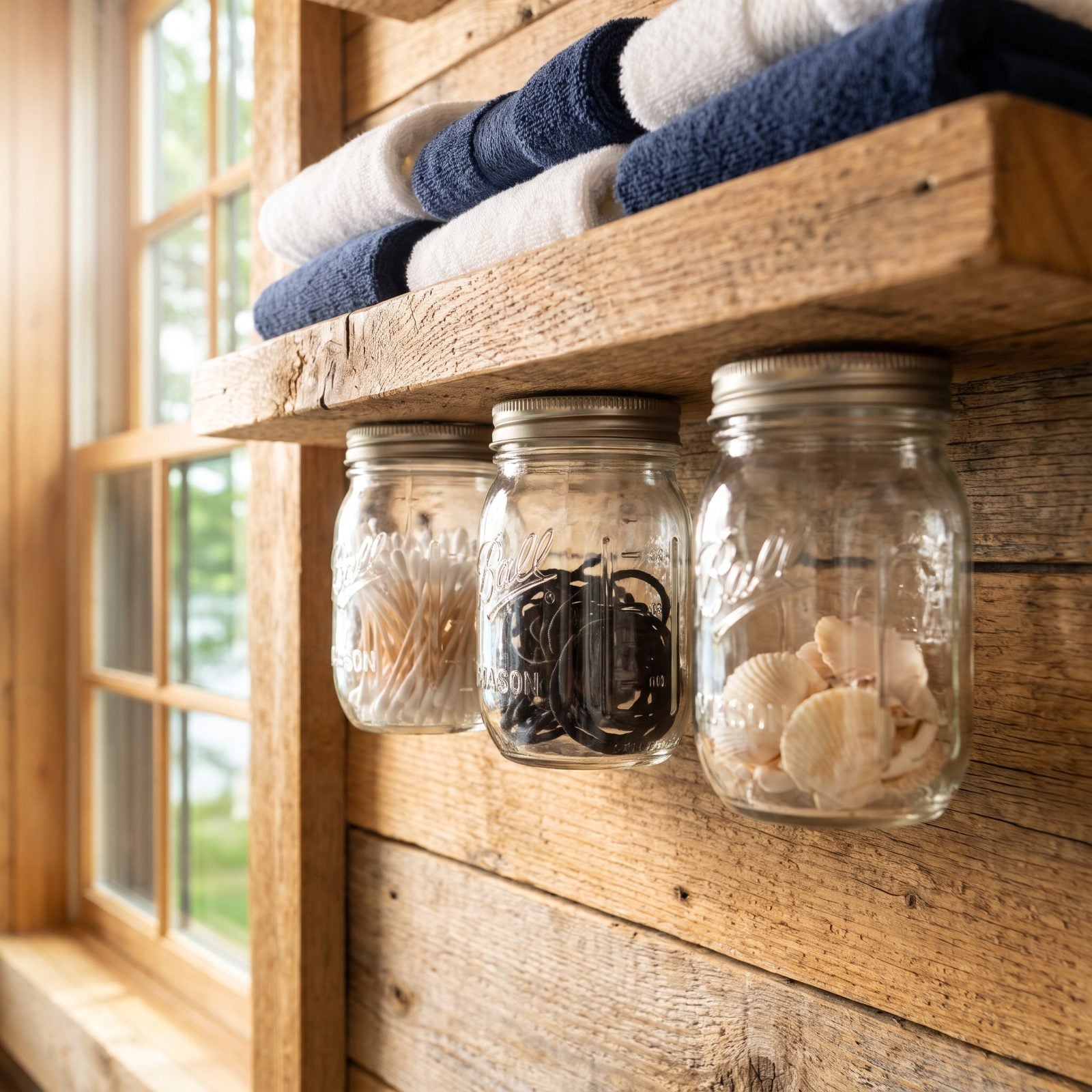
Dead space under a shelf is the most wasted real estate in any cabin. Screw a mason jar lid to the shelf’s underside, fill the jar, twist it back into the lid, and suddenly cotton swabs, hair ties, and loose change float in mid-air where nothing else lives.
Clear glass means you spot what’s inside without opening a thing. The pint size suits small stuff; the quart handles taller items like makeup brushes. One warning, though. Don’t overfill, or the weight will strip a cheap pine shelf, so hit a stud or use a thicker board.
21. Hide Toilet Paper in a Lidded Fishing Creel
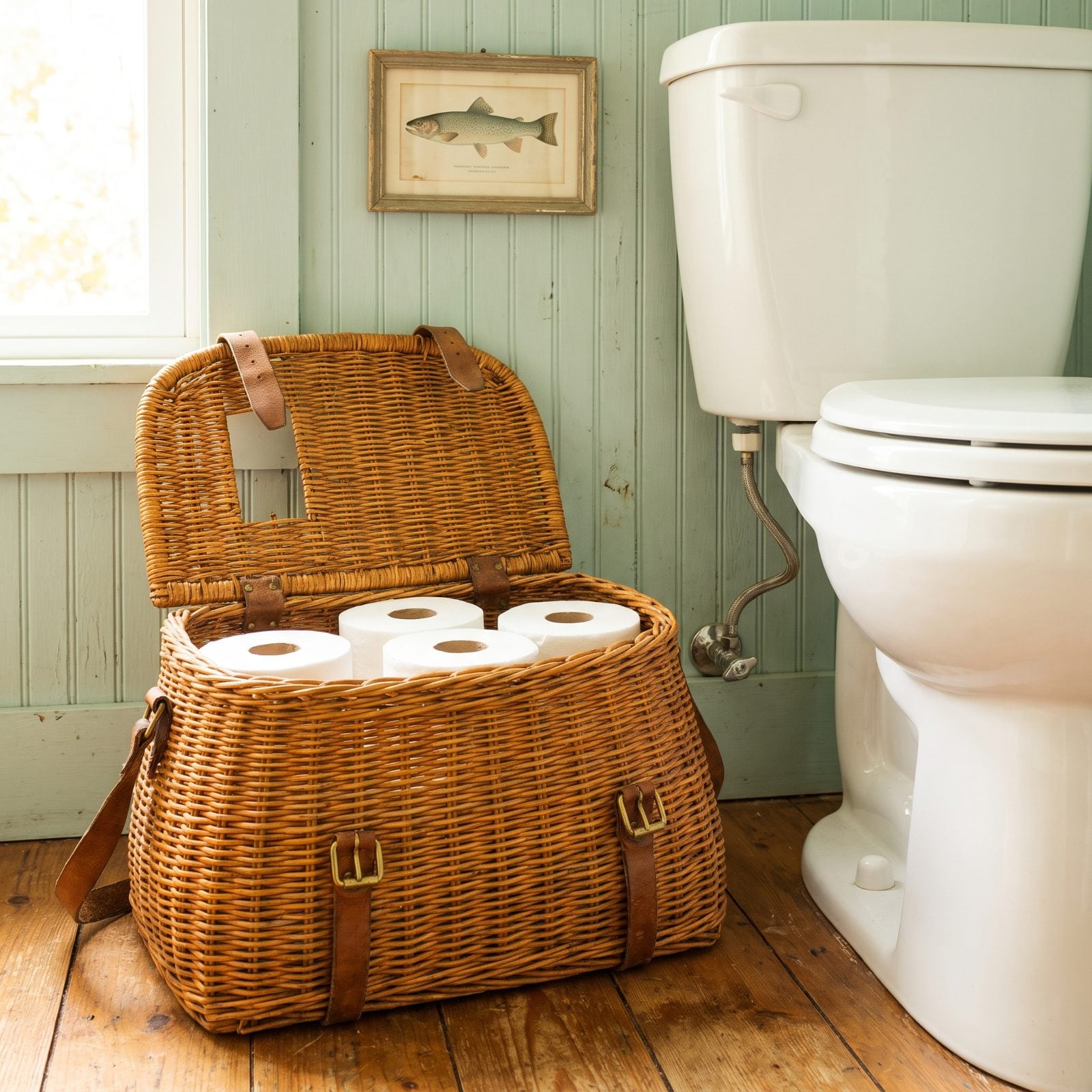
A stack of spare toilet paper is the least charming thing in any room. In a lake house, where the whole point is looking like you don’t care but secretly having everything handy, a bare plastic tower is a problem.
An old fishing creel solves it. The willow basket swallows a full multipack, the hinged lid hides the evidence, and the leather strap lets you haul it to the next bathroom when supplies run low. Real vintage creels run twenty to sixty dollars at flea markets, but a reproduction works just as well, and nobody’s casting with it anyway.
20. Hang Cleaning Bottles From a Tension Rod
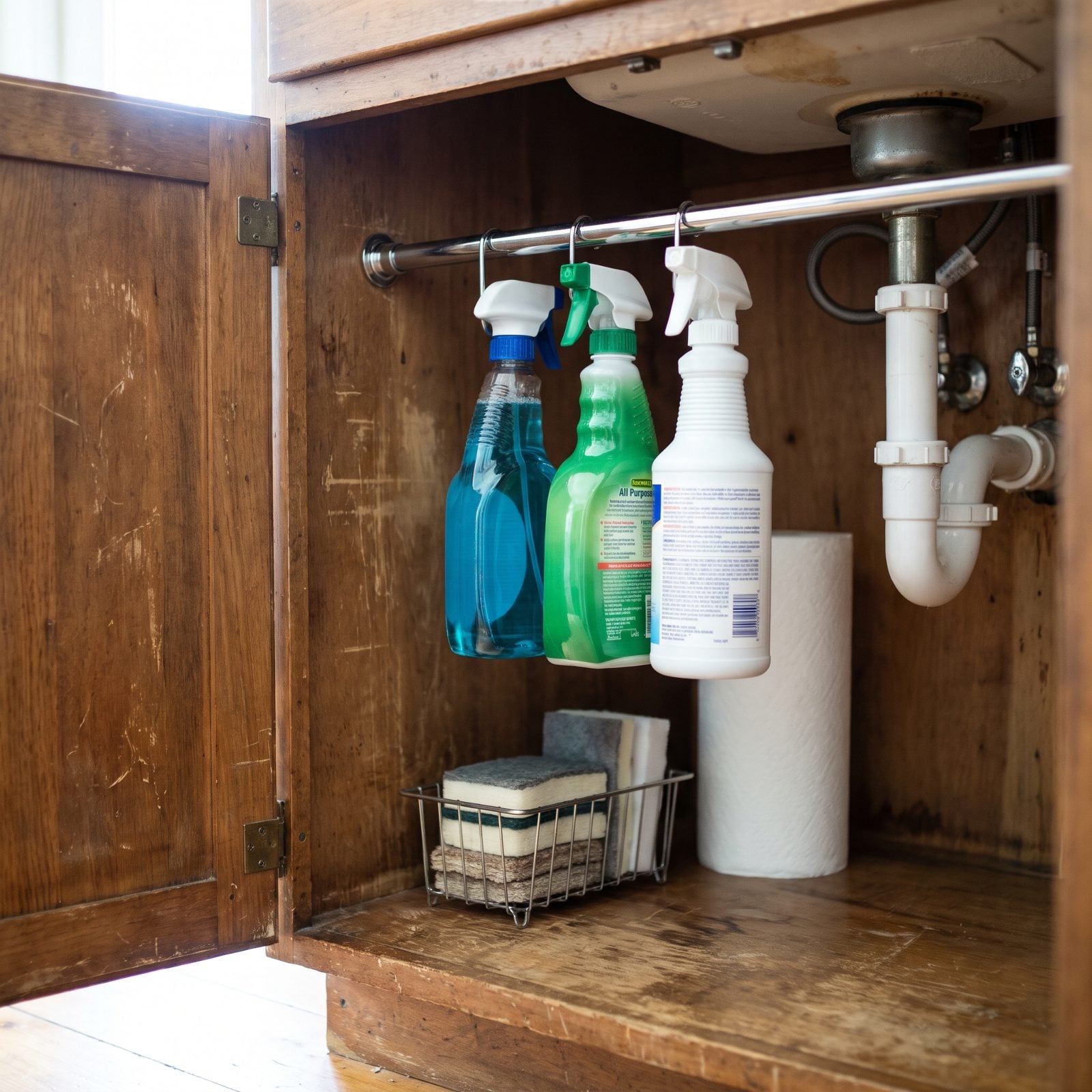
Under-sink chaos is universal. Bottles tip, leak, and crowd each other until the cabinet becomes a place you shove things and shut the door fast.
Wedge a spring-loaded tension rod across the cabinet near the top and the whole upper half turns into a hanging rack. Hook the spray bottles by their trigger handles so they hang upright with the nozzles above the rod, which leaves the cabinet floor wide open for sponges, trash bags, and the extra dish soap. Costs about six bucks and takes ten seconds. No drilling, no brackets, nothing permanent that a rental owner would mind.
19. Mount a Fold-Down Drying Rack Behind a Door
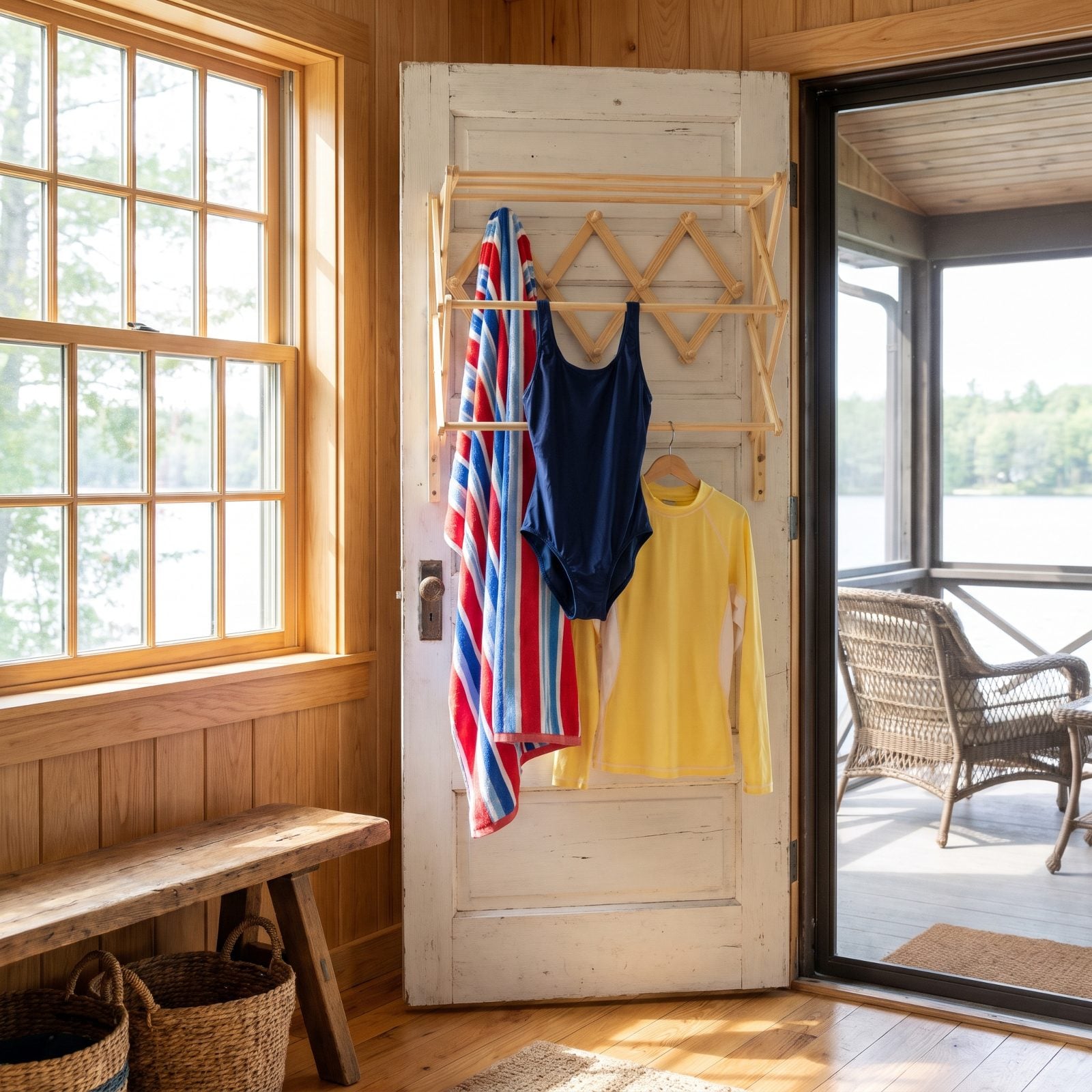
Wet swimsuits end up on every doorknob, chair back, and faucet in the house. By August the place smells faintly of pond.
A folding accordion rack screwed to the back of a mudroom or bathroom door pops out to hold a dozen dripping things, then folds flat when you’re done. Pine ones cost twenty to thirty dollars. What sells me is the location, because that stretch of vertical space behind a door does absolutely nothing otherwise. Suits actually dry overnight instead of marinating in a heap, and the next morning nobody’s wrestling into a cold damp one.
18. Add Drainage Holes to Outdoor Shoe Cubbies
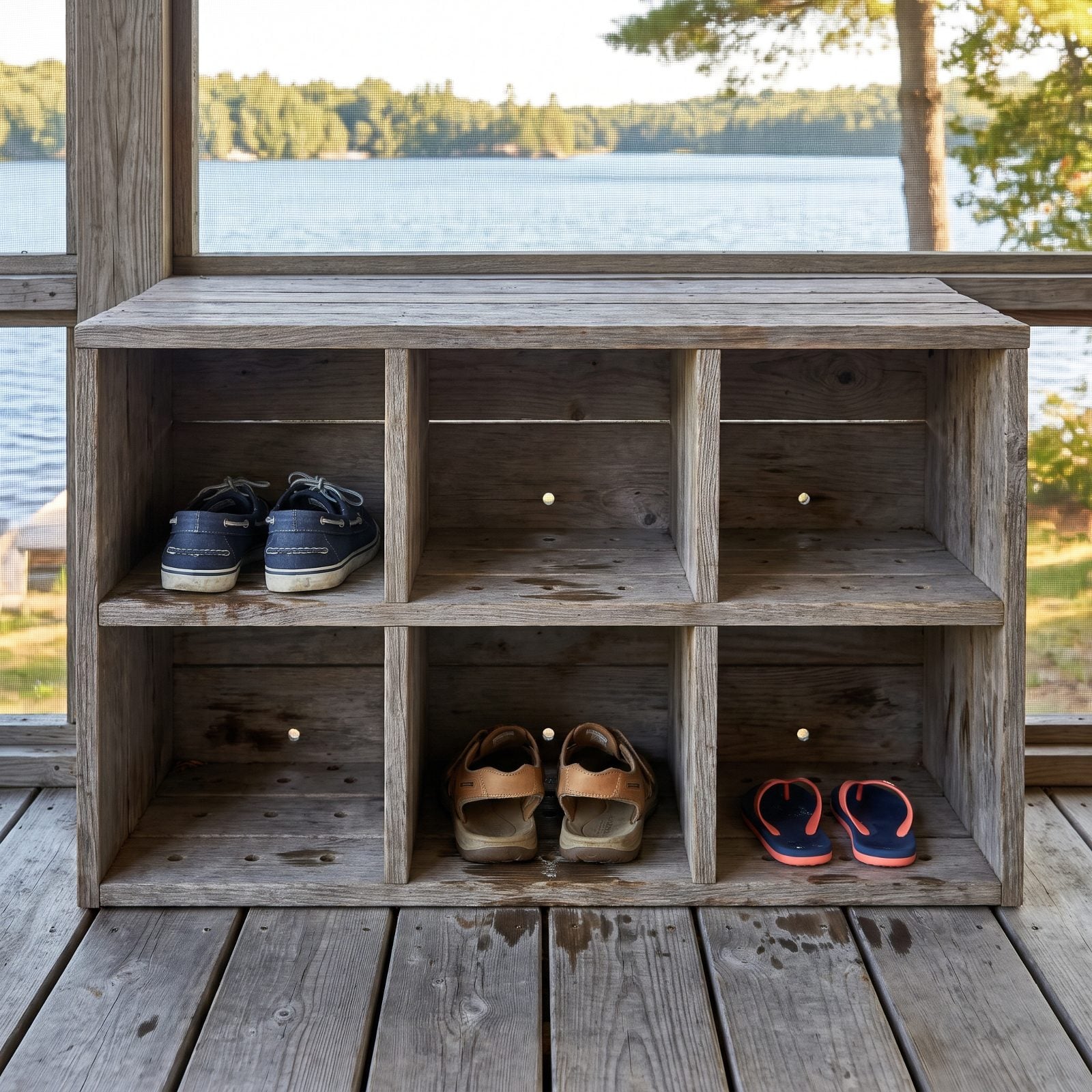
A shoe cubby by the door is smart. A shoe cubby with no drainage, holding wet water shoes and dripping flip-flops, becomes a swamp with a smell you’ll remember.
So drill a few half-inch holes in the bottom of each compartment, and water runs straight through onto the deck or a drip tray instead of pooling in the corners. If the cubby sits on a porch, that’s the whole difference between shoes that dry and shoes that grow something.
17. Hang Chip Bags From Curtain Rings
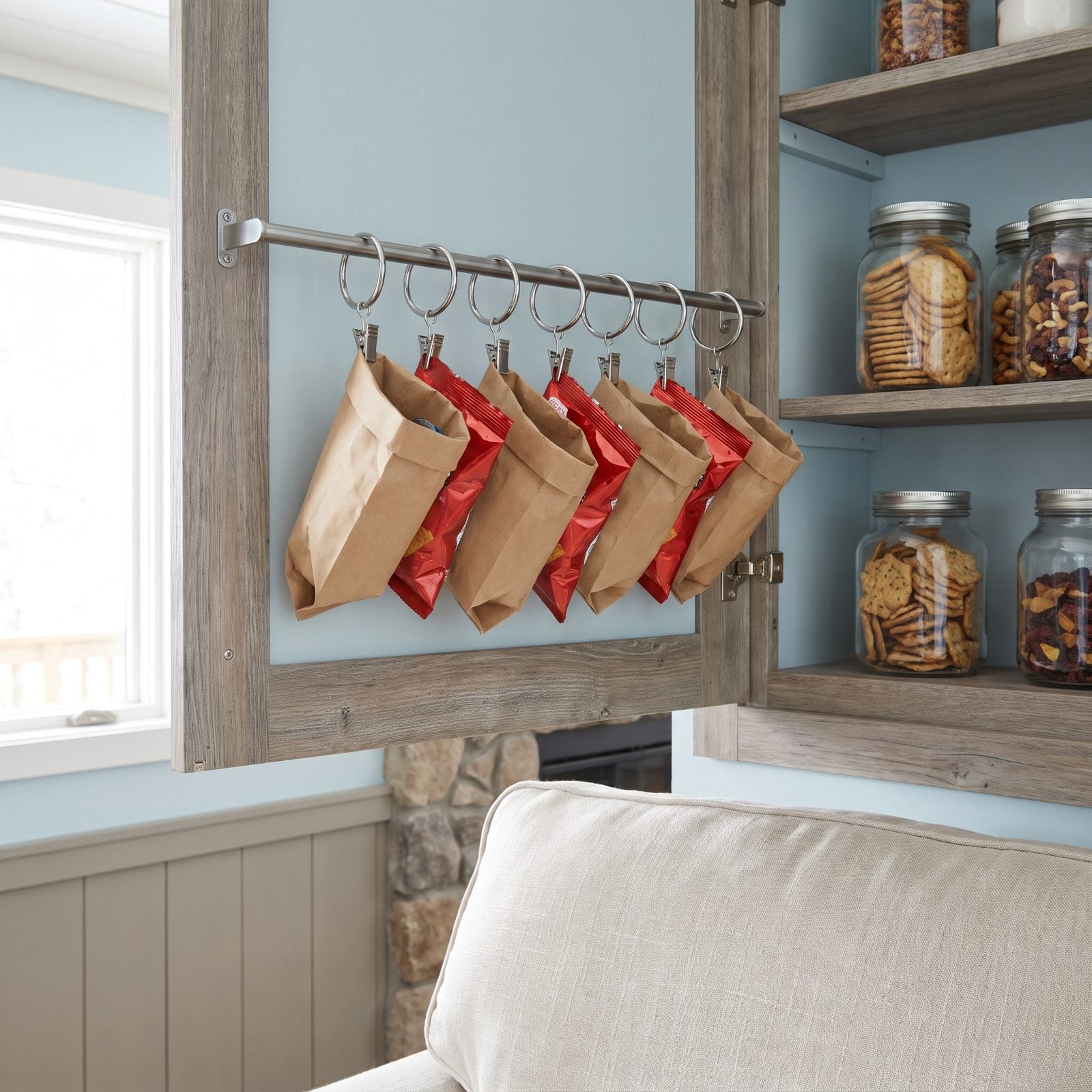
Loose bags of chips and pretzels are the raccoons of pantry clutter. They flop over, spill, go stale, and eat a whole shelf for nothing.
Decant snacks into brown paper sacks or zip-top bags and clip each bag’s folded top shut with a clip-style curtain ring, then thread the rings onto a slim rod mounted inside a cabinet door or along a pantry wall. Bags hang in a row, sealed shut but easy to grab, visible at a glance. A pack of rings costs a few dollars, and you’ll stop buying duplicate pretzels because you can finally see you already have three bags.
16. Store Picnic Supplies in a Grab-and-Go Market Basket
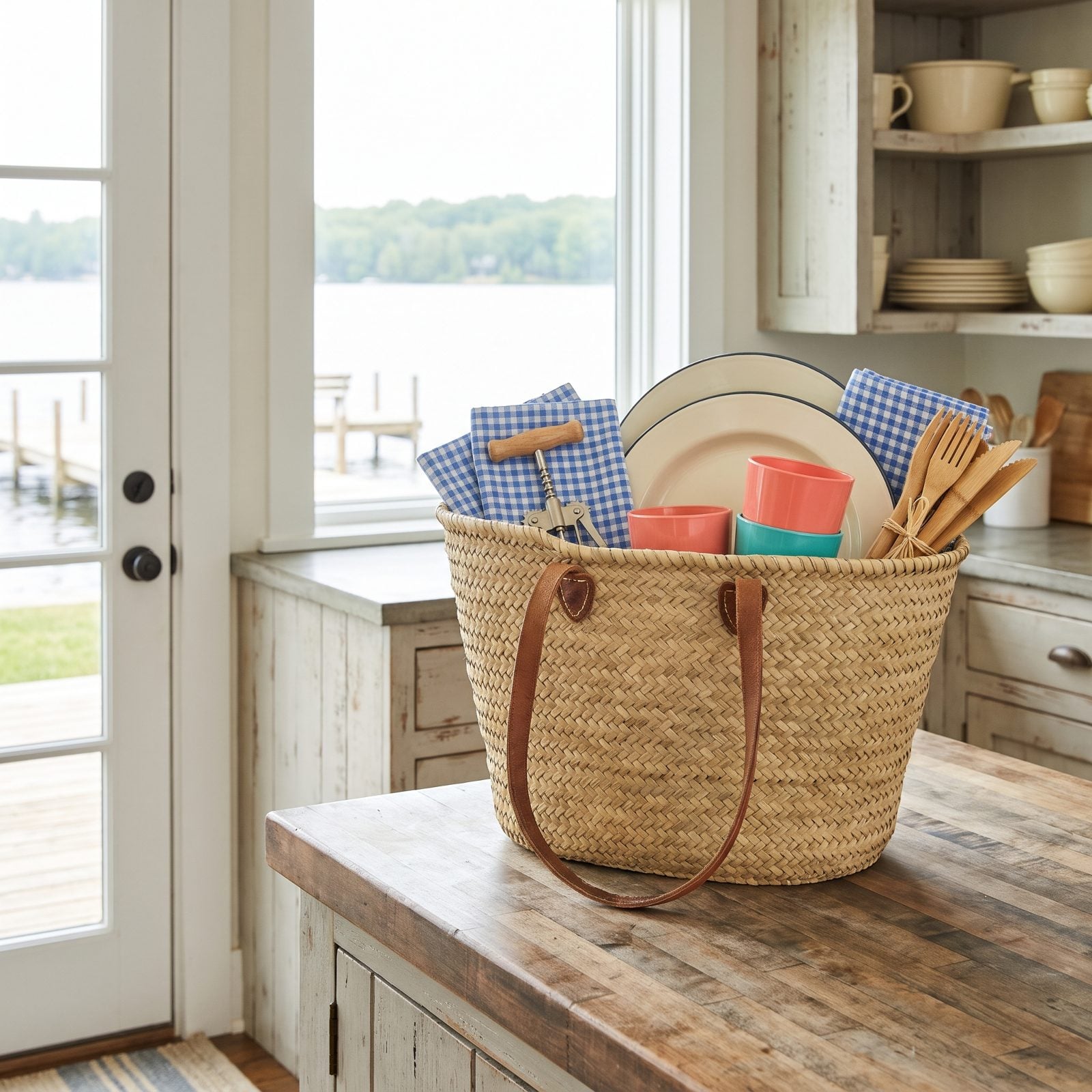
The gap between wanting a lakeside picnic and actually having one is usually twenty minutes of hunting for forks, cups, and the bottle opener. By then everyone’s lost interest.
Keep one market basket permanently loaded with the picnic kit: unbreakable plates, melamine cups, cloth napkins, a corkscrew, and a set of bamboo utensils. It lives packed on a shelf by the door. When the light goes golden on the water, you grab the basket and go. The flat bottom sits steady on a dock, and the open weave lets sand shake right out when you get home.
15. Keep S’mores Ingredients in a Lidded Campfire Caddy
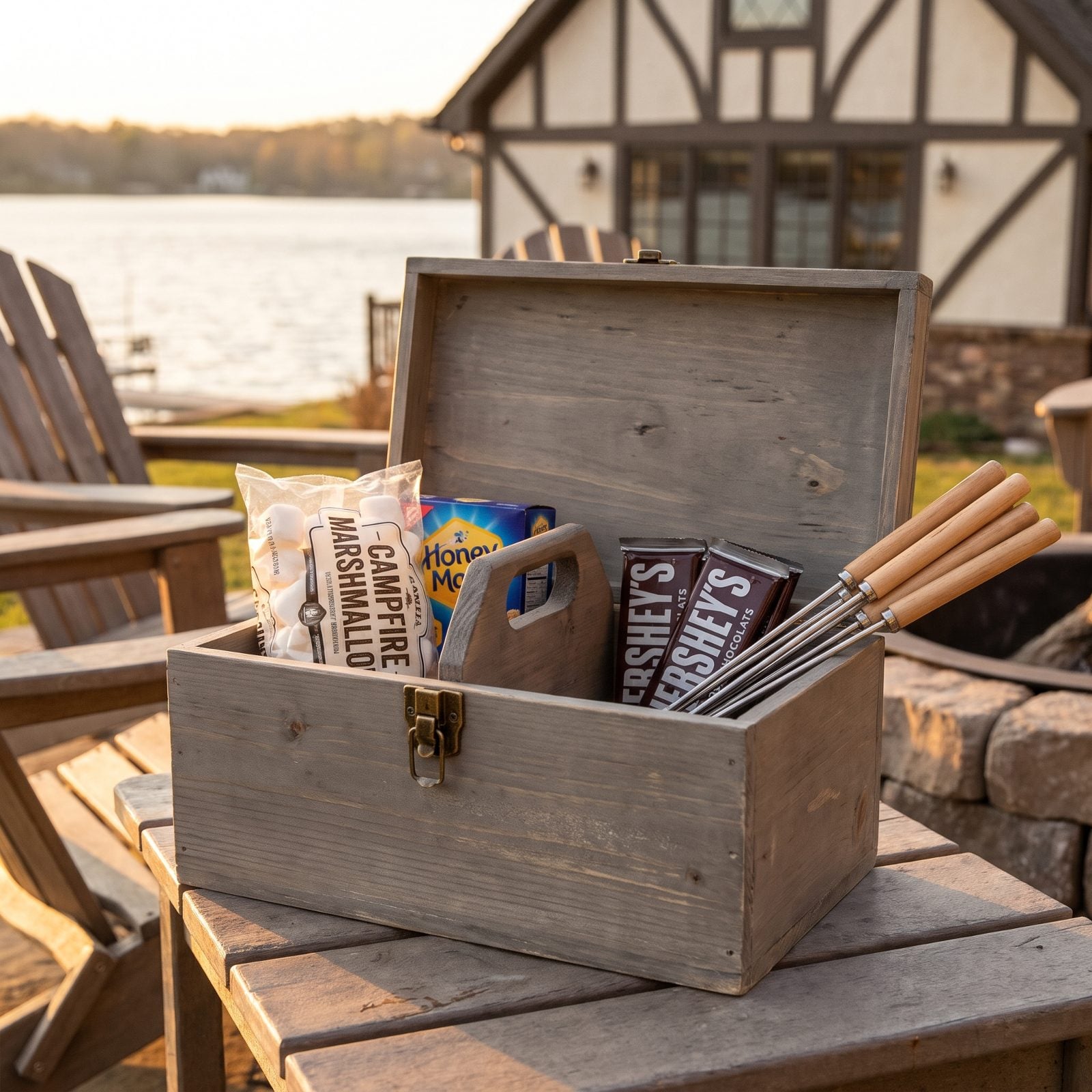
S’mores night dies on the vine when the marshmallows are in one cabinet, the graham crackers go stale in another, and nobody can find the roasting sticks.
A lidded wooden caddy keeps the whole operation in one place. A center divider splits it in two: marshmallows and grahams share one side, the chocolate bars go in the other, and the lid closes to keep bugs and critters out of the food between fires. Pop it open by the pit and everything’s right there, done.
Keep a little pack of wet wipes in there too, because s’mores are a crime scene and you’re not walking those sticky hands back into the cabin. That part is the trick nobody mentions.
14. Mount a Paper-Towel Holder for Trash-Bag Rolls
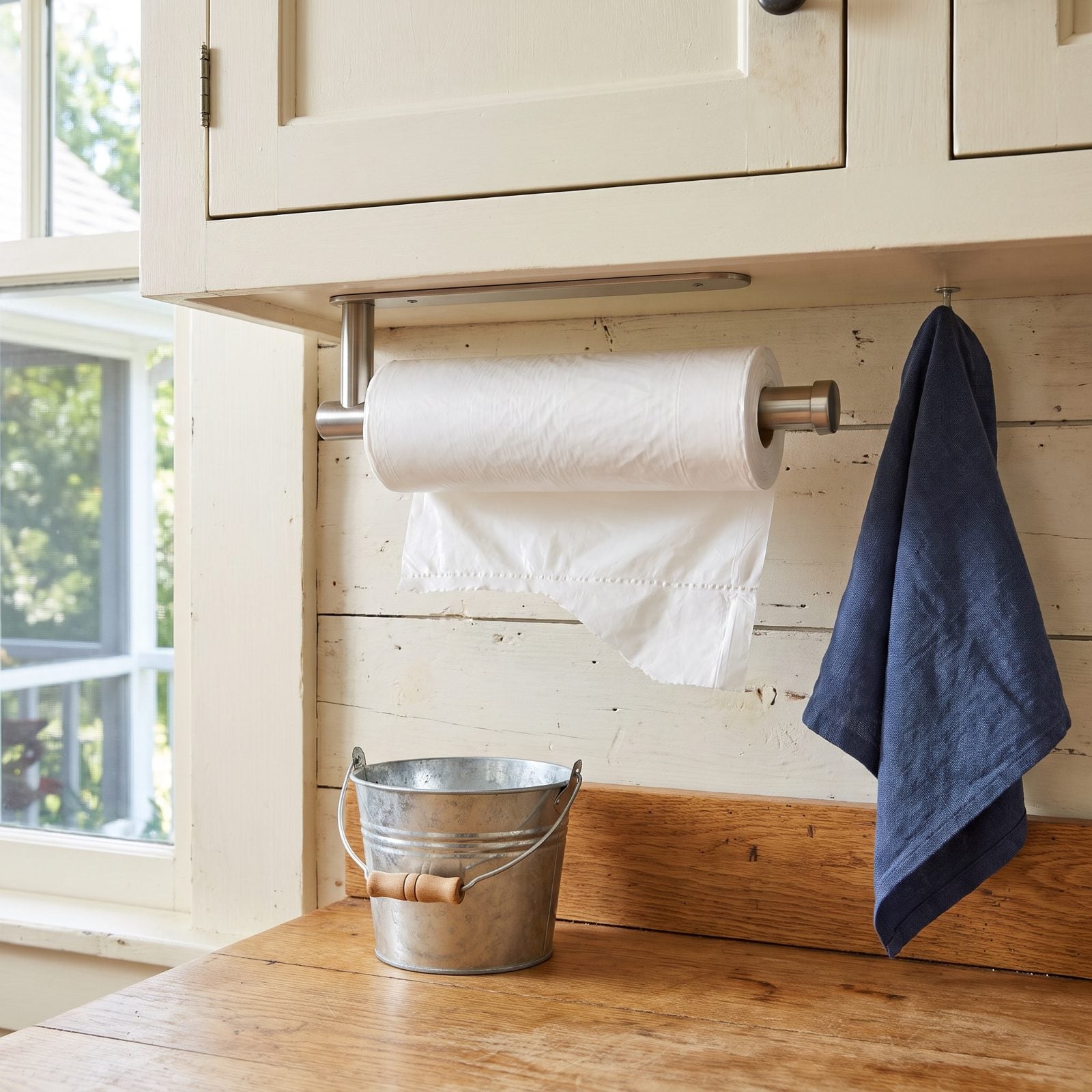
Trash bags come on a roll, but nobody designs cabin storage around that fact. So the box ends up crushed under the sink with the bags escaping one by one.
Screw a cheap under-cabinet paper-towel holder to the inside of a lower door or the wall beside the bin, then drop the roll on. You pull one off, the next one waits. No digging. No half-open box of plastic confetti.
13. File Reusable Water Bottles in Wine-Rack Slots
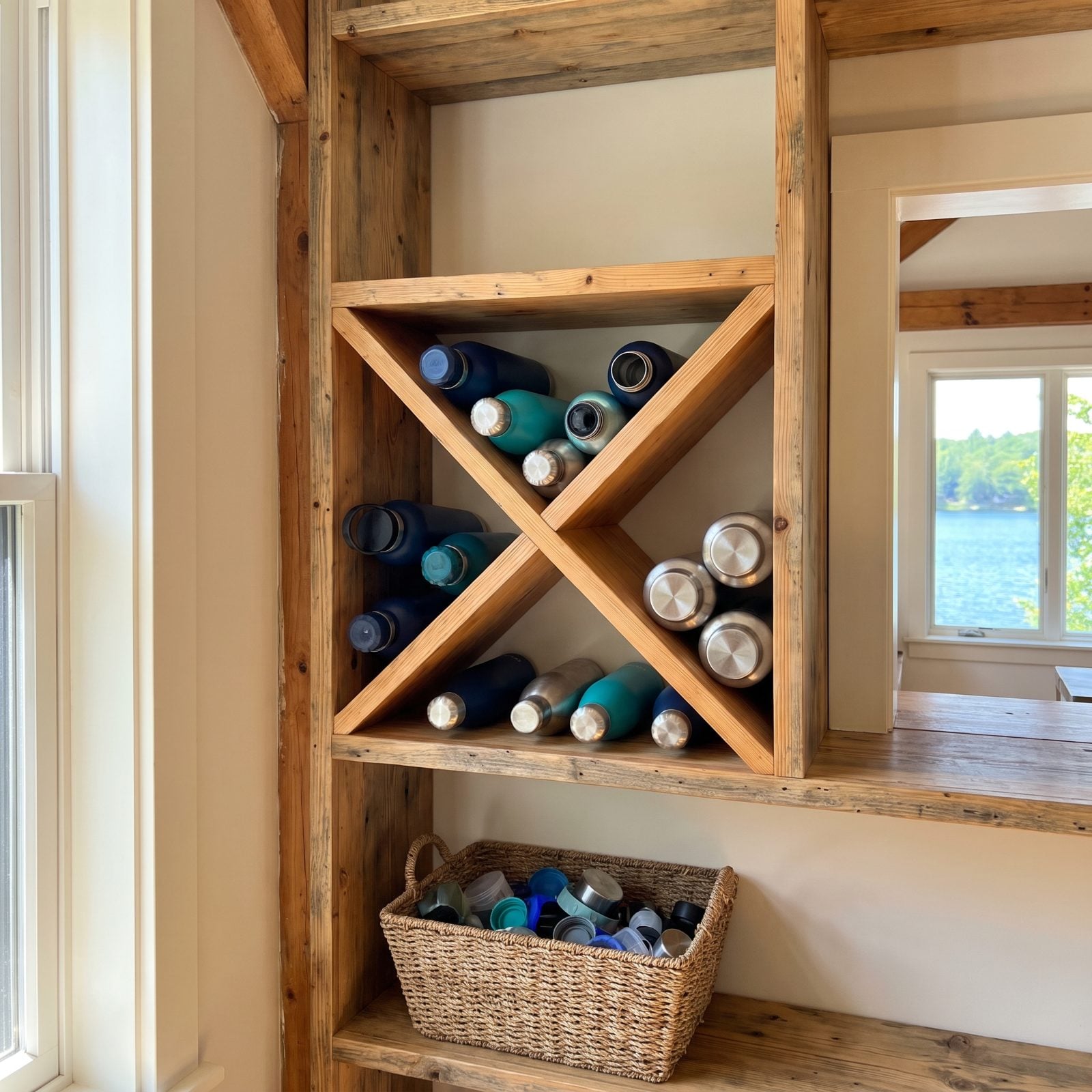
Water bottles are the worst cabinet citizens. They roll, they topple, and they bury the lids somewhere you’ll find in October.
A countertop wine rack solves it cold. The cradle that holds a bordeaux on its side holds a steel bottle just as well, and the open front means you grab one on the way out the door without a single thing falling over. One slot per person, one for the dog’s collapsible bowl. Done.
12. Store Grill Tools in a Repurposed Mailbox
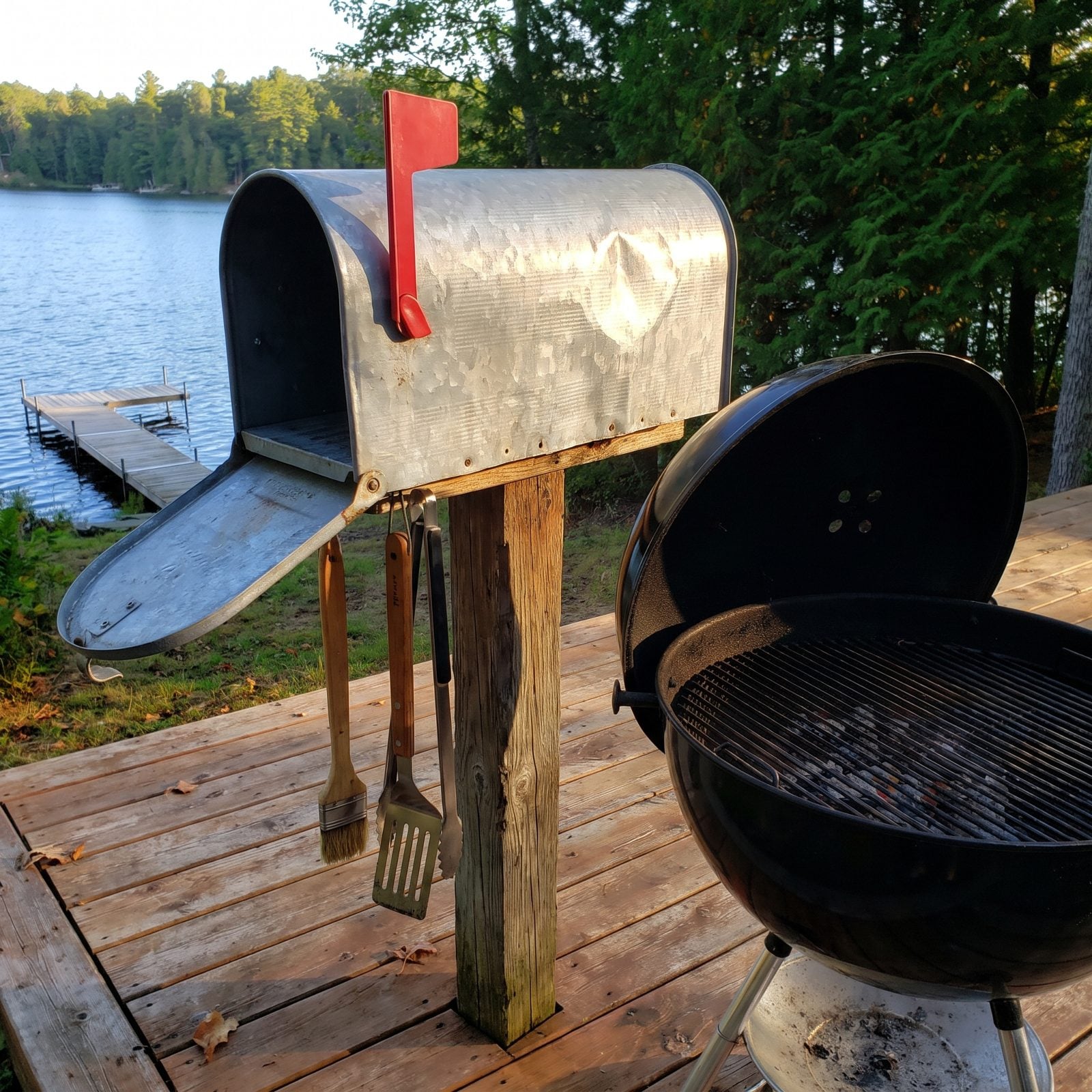
A mailbox by the grill looks like a joke until the first rainstorm. Then it looks like genius.
Standard rural mailboxes are weatherproof and sturdy, and a large one swallows long-handled tongs, a spatula and a basting brush with the door shut. Mount one on the deck rail or a post next to the grill and your tools stay dry inside, within arm’s reach of the coals. No more hauling greasy utensils through the kitchen. The flag’s purely for show, but leave it up anyway.
11. Keep Marshmallow Sticks in a Capped PVC Tube
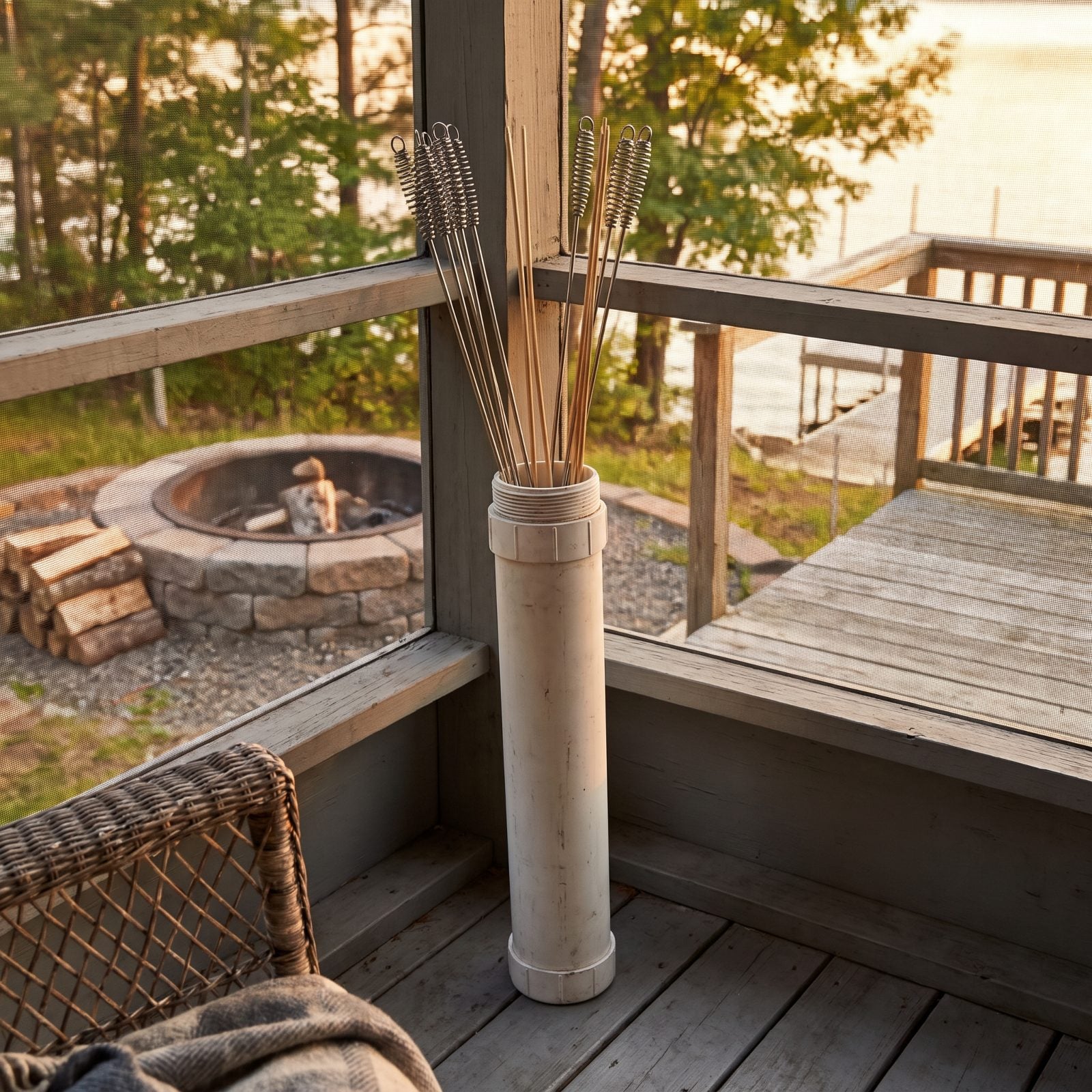
Roasting sticks are the junk drawer of the outdoors — pointy, two feet long, impossible to store flat, and forever skewering everything else in the closet.
Cut a length of wide PVC pipe, cap one end, and stand it in a corner of the porch or the mudroom. The sticks drop in point-down, the whole bundle takes up a coffee-can footprint, and nobody stabs a hand reaching for the firewood. Cap the top too if you’re moving it anywhere.
10. Mount Spice Tins Magnetically Inside a Cabinet Door
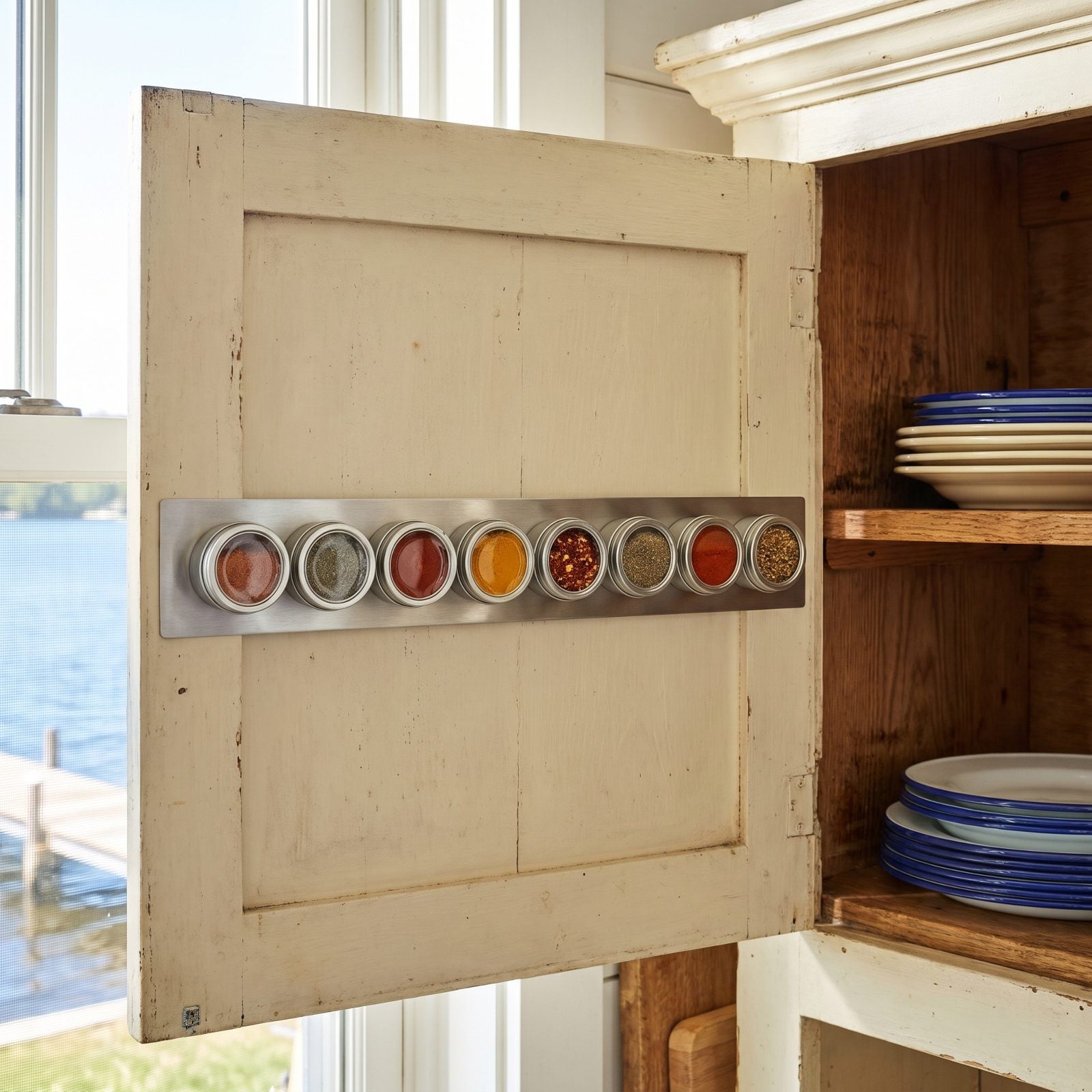
Cabin kitchens never have enough counter or shelf. The inside of the cabinet door is dead space, and it’s exactly where your spices belong.
Stick a thin magnetic strip or a steel sheet to the door’s interior and clap small magnetic tins onto it. Clear lids, so you read them at a glance. Open the door, the whole rack faces you, and your shelf is free for the stuff that actually needs a shelf. Bonus: it keeps the paprika out of the lake-house humidity better than an open rack would.
9. Use Ice-Cube Trays to Sort Tiny Fishing Hardware
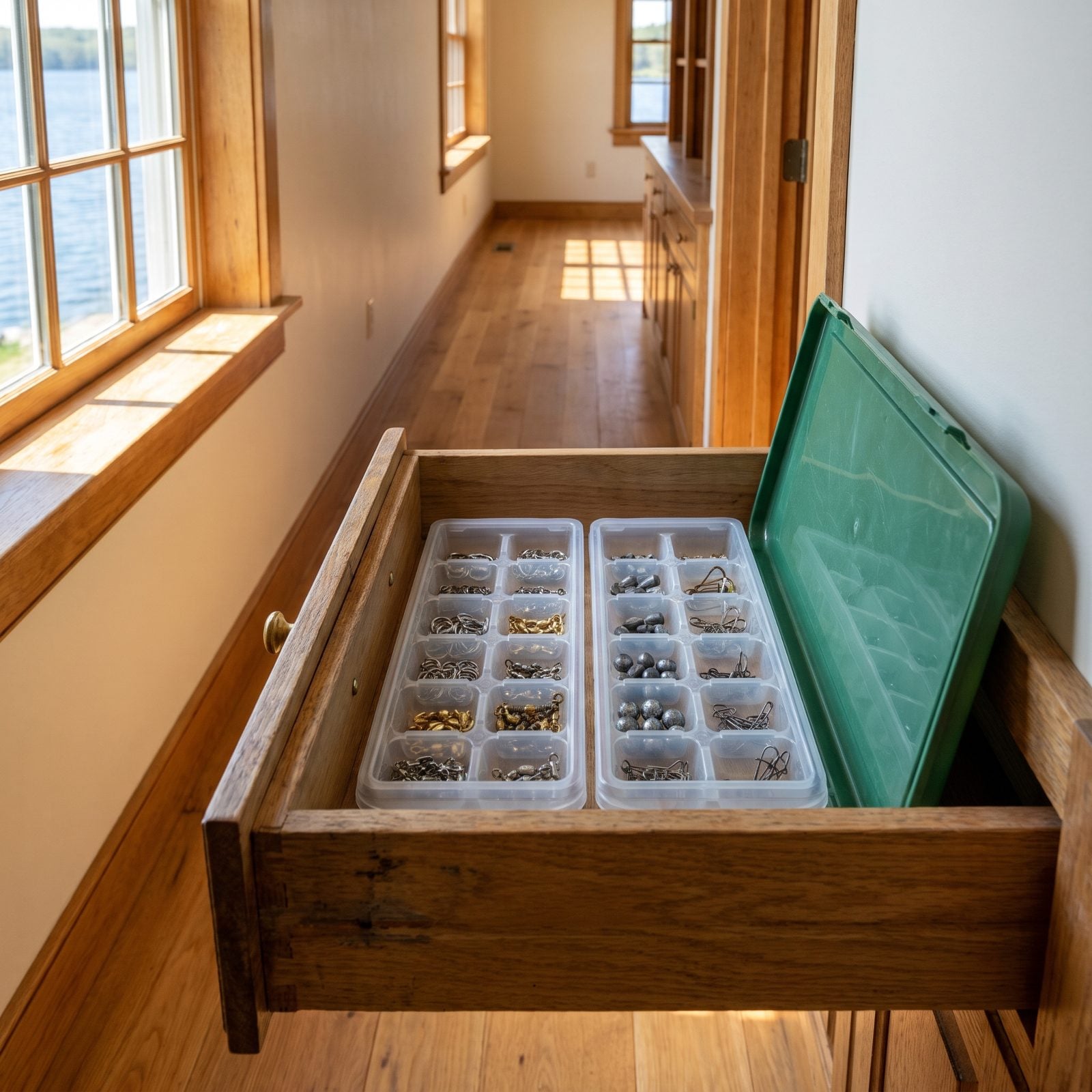
Swivels, split rings, sinkers, snaps. All tiny, all identical from across the room, all guaranteed to end up in one maddening pile.
An old ice-cube tray gives you a dozen little bins for about a dollar. Sort by size or by type, slide the tray into a drawer, and you can actually see what you’ve got before a trip instead of pawing through a baggie on the dock at dawn.
8. Organize Batteries in a Clear Tackle Box
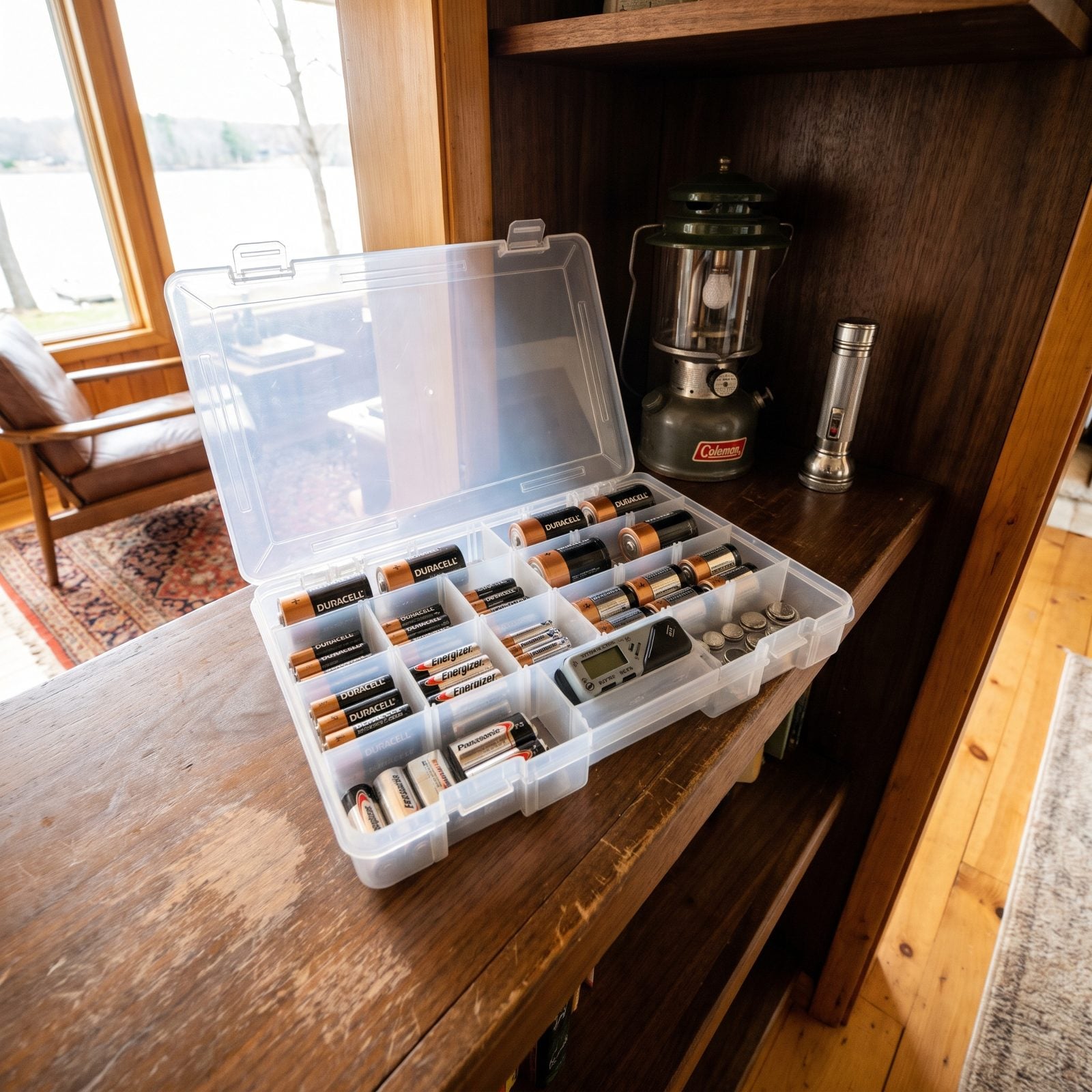
Everyone has the battery drawer. Loose AAs rolling into the dead 9-volts, a corroded C that’s been in there since the Clinton administration, and no way to tell the fresh from the finished.
A clear tackle box with adjustable dividers fixes all of it. Sort the big D and C cells into their own compartments, corral the smaller AAs and AAAs and the coin cells in the rest, keep a cheap tester inside, and you shelve the whole thing somewhere dry. The flashlight that always died mid-season? Now you can actually feed it.
7. Hide Charging Cables Inside a Hollowed-Out Book Box
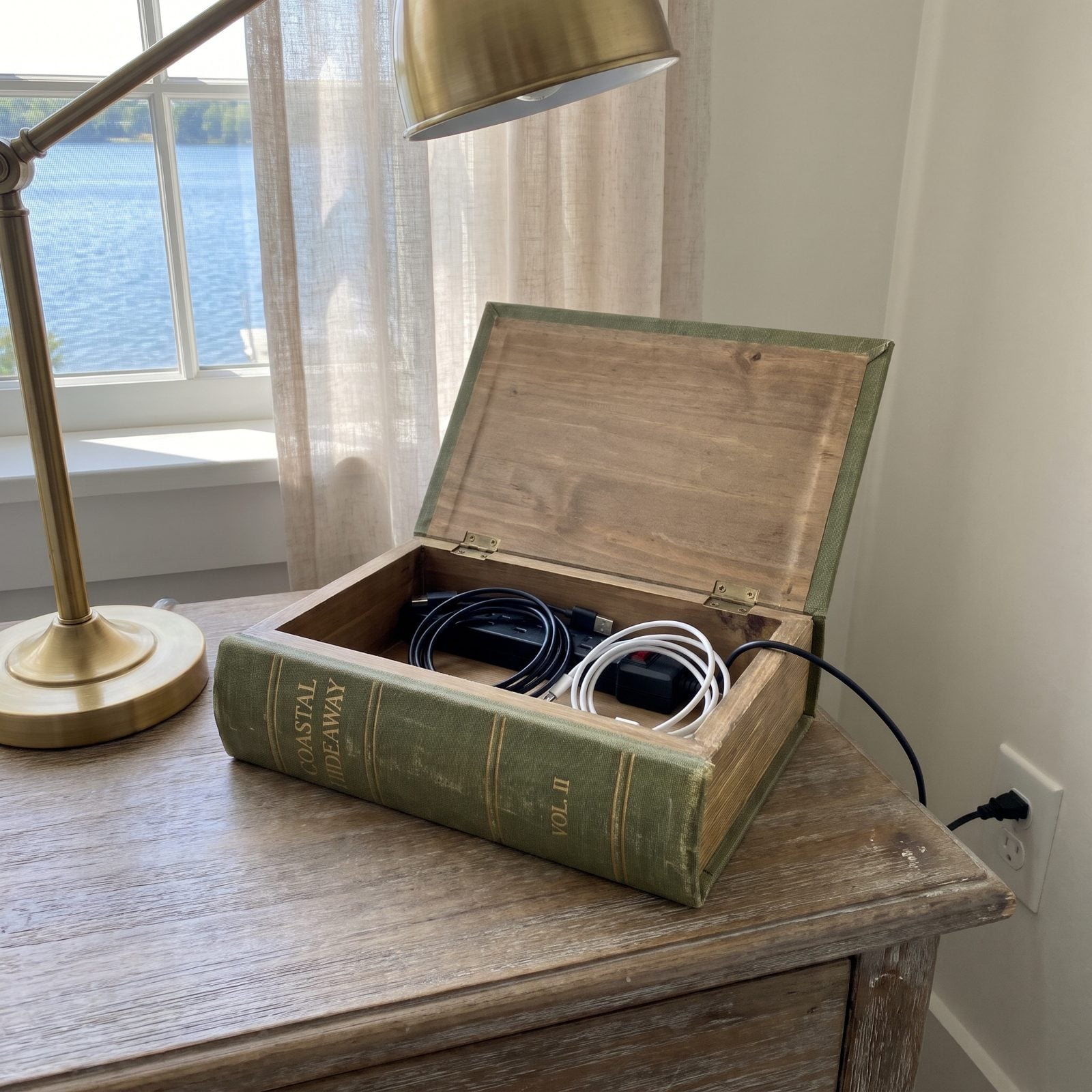
Charging cables multiply like rabbits and look like a crime scene on a nightstand. Guests leave theirs behind, you add yours, and suddenly there’s a nest no one will claim.
A hollowed-out book box, the kind people use to hide a spare key, swallows a small power strip and the coiled cords. Cut a small notch in the back for the plug to escape, run one cable out the top, and the whole mess sits on the shelf looking like a novel nobody’s read. It might be the tidiest thing in the guest room.
6. Clip Cabin Keys to a Labeled Carabiner Board
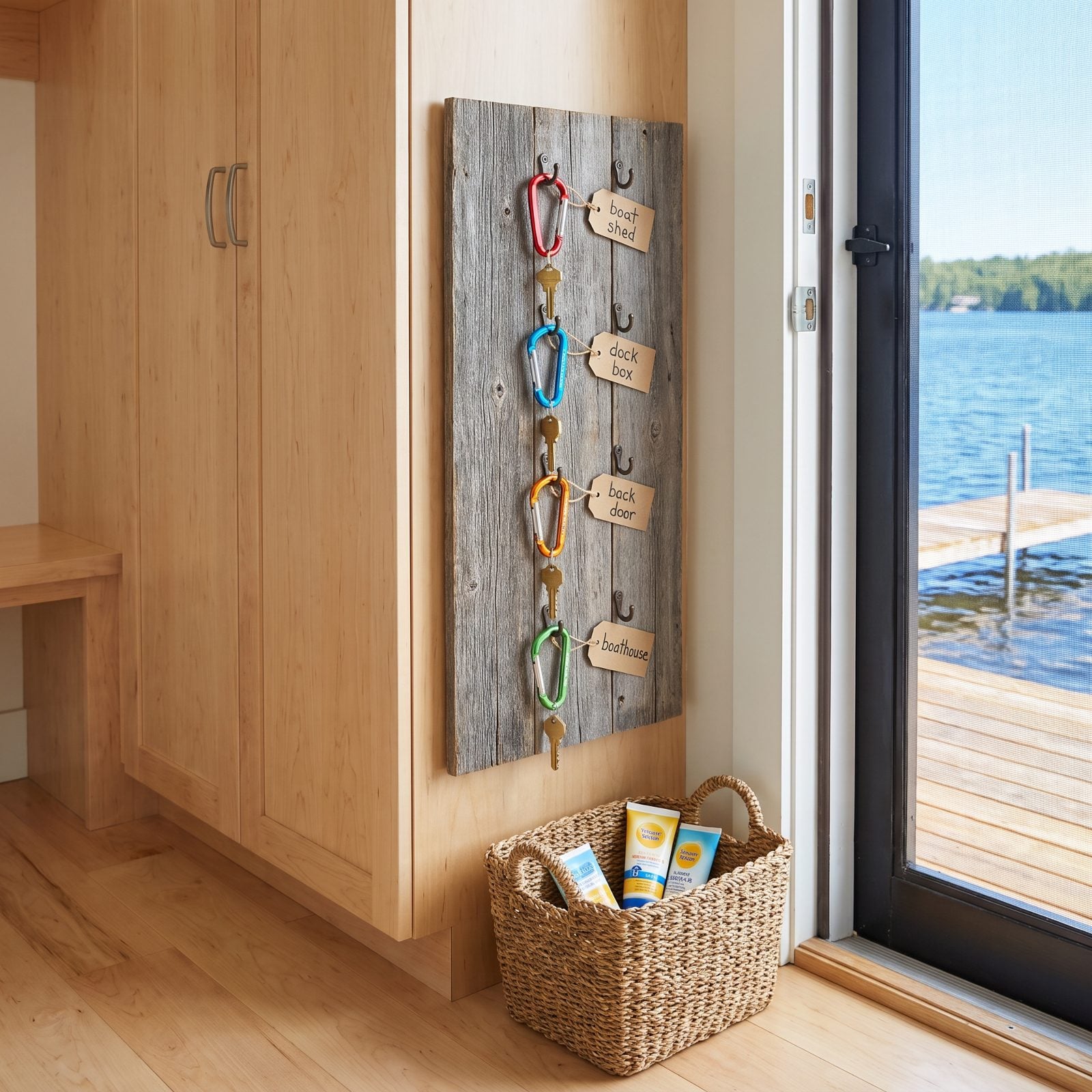
A lake house breeds keys. Boat shed, dock box, boathouse, the back door that sticks, the padlock on the kayak rack. On a bowl-by-the-door system they become one anonymous jingling clump.
Screw a row of hooks to a weathered board in the mudroom and give every key its own colored carabiner with a label. Clip and go. The carabiner clips to a belt loop on the walk down to the dock, which matters the day you drop a key and it finds the bottom of the lake. Ask us how we know.
5. Mount Sunglasses on a Bungee-Cord Frame
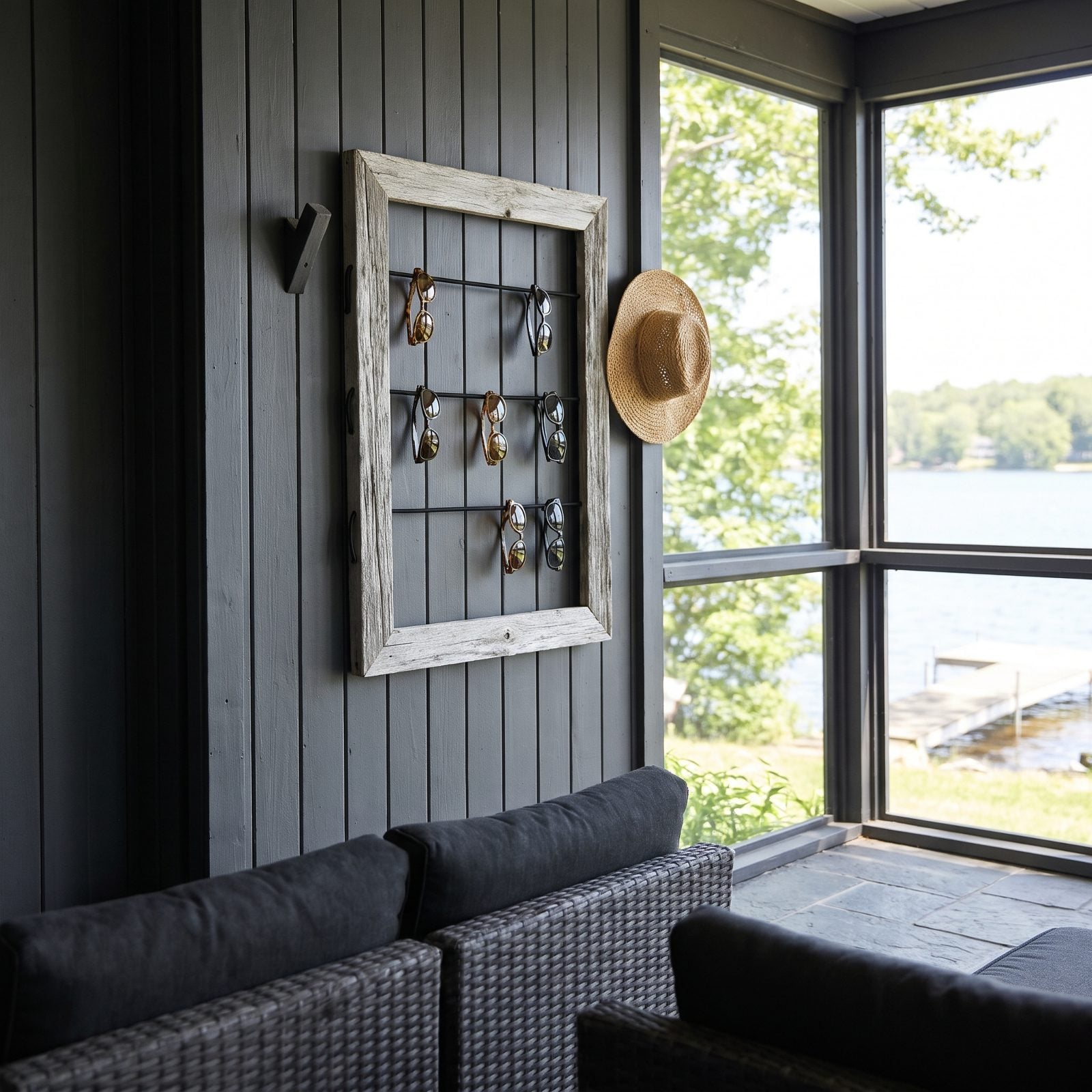
Sunglasses at a lake house wander. They end up on heads, in boats, under couch cushions, cracked in the bottom of a tote.
Build a shallow frame, string a few taut bungee cords across it horizontally, and hook each pair over the cord by one arm. The elastic grips the frames so they don’t slide, you can see every pair at once, and it holds everything from reading cheaters to the good polarized ones. Hang it by the door to the dock. That’s where sunglasses belong.
4. Hang Hats From Shower-Curtain Rings on a Rod
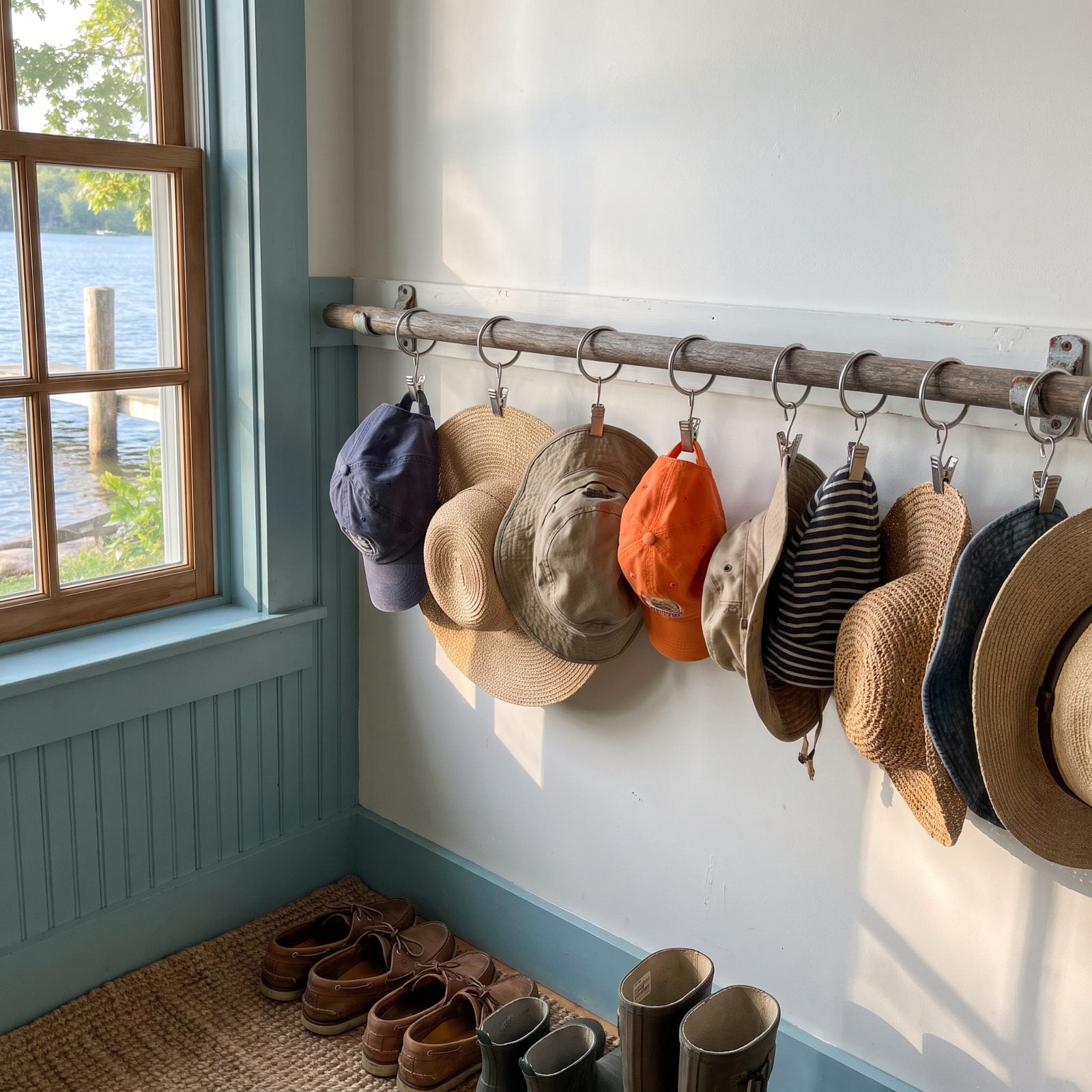
Hats are terrible at sitting on a shelf. Stack them and the brims crush. Toss them in a bin and the one you want is always on the bottom, folded in half under somebody’s swim goggles.
Mount a curtain rod or a plain wooden dowel along the entry wall, thread on a row of shower-curtain rings, and hang one hat per ring. Ball caps clip on through the gap above the back strap, and wide-brim sun hats clip on by the edge of the brim and hang against the wall. The rings slide, so you can bunch them up when the rod gets crowded or spread them out when everyone’s home for the long weekend.
It costs almost nothing, and every hat in the house is visible at eye level on the way out the door.
3. Turn an Old Shutter Into an Entryway Organizer
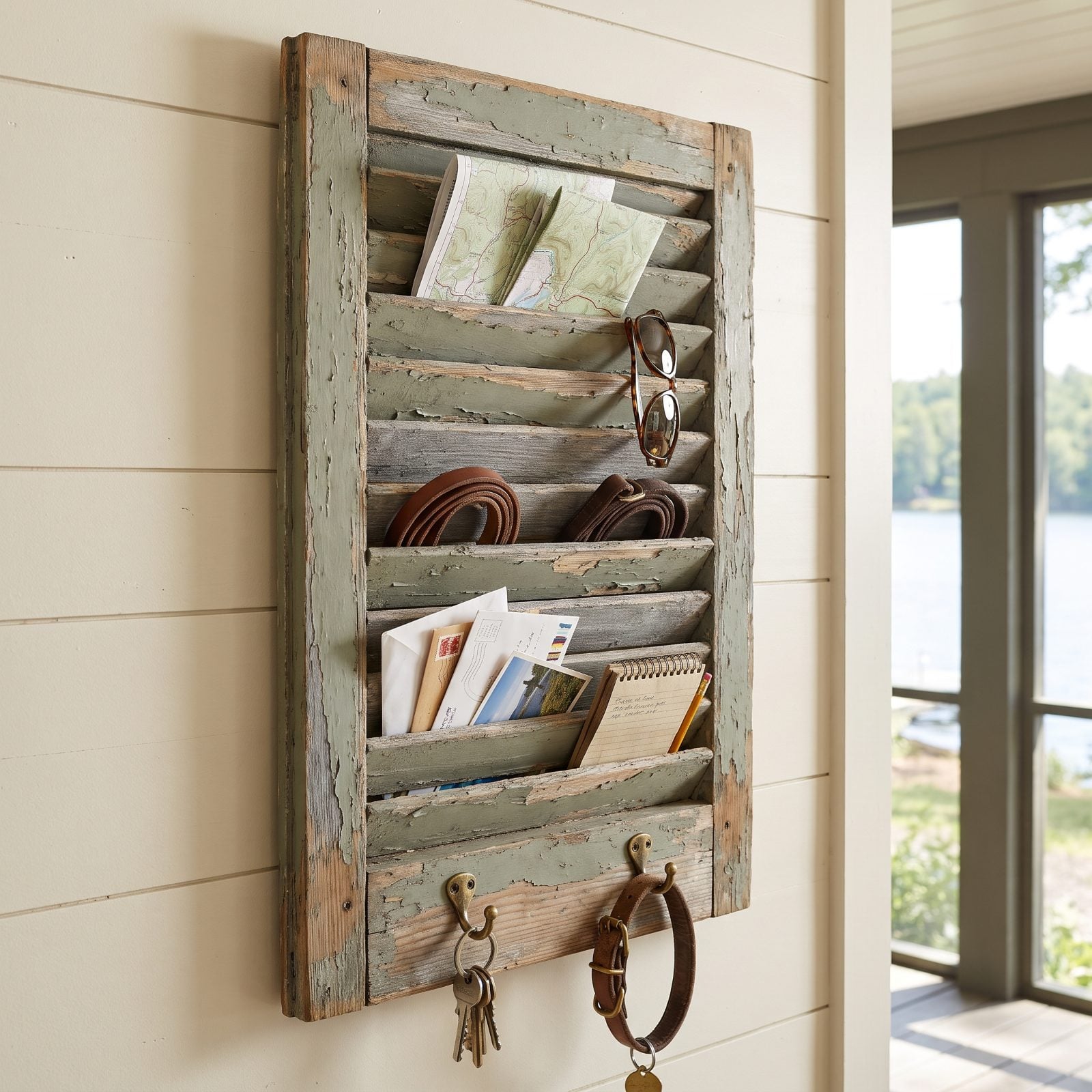
Every lake town has a salvage pile with an old louvered shutter in it, paint peeling, hinges long gone. Grab it. It’s halfway to an entryway organizer already.
Screw it to the wall vertically, and the angled slats become slots for flat stuff: mail, tide and fishing calendars, takeout menus, the boat registration you swore you’d keep handy. Add a row of hooks along the bottom rail for dog leashes and canvas totes, and maybe a small ledge on top for sunglasses or a jar of loose change.
Leave the chipped paint if you like the look, or sand it and match it to the trim. Either way, it reads as charm instead of clutter, and the paper pile finally has an address.
2. Mount Baskets Between Porch Rafters
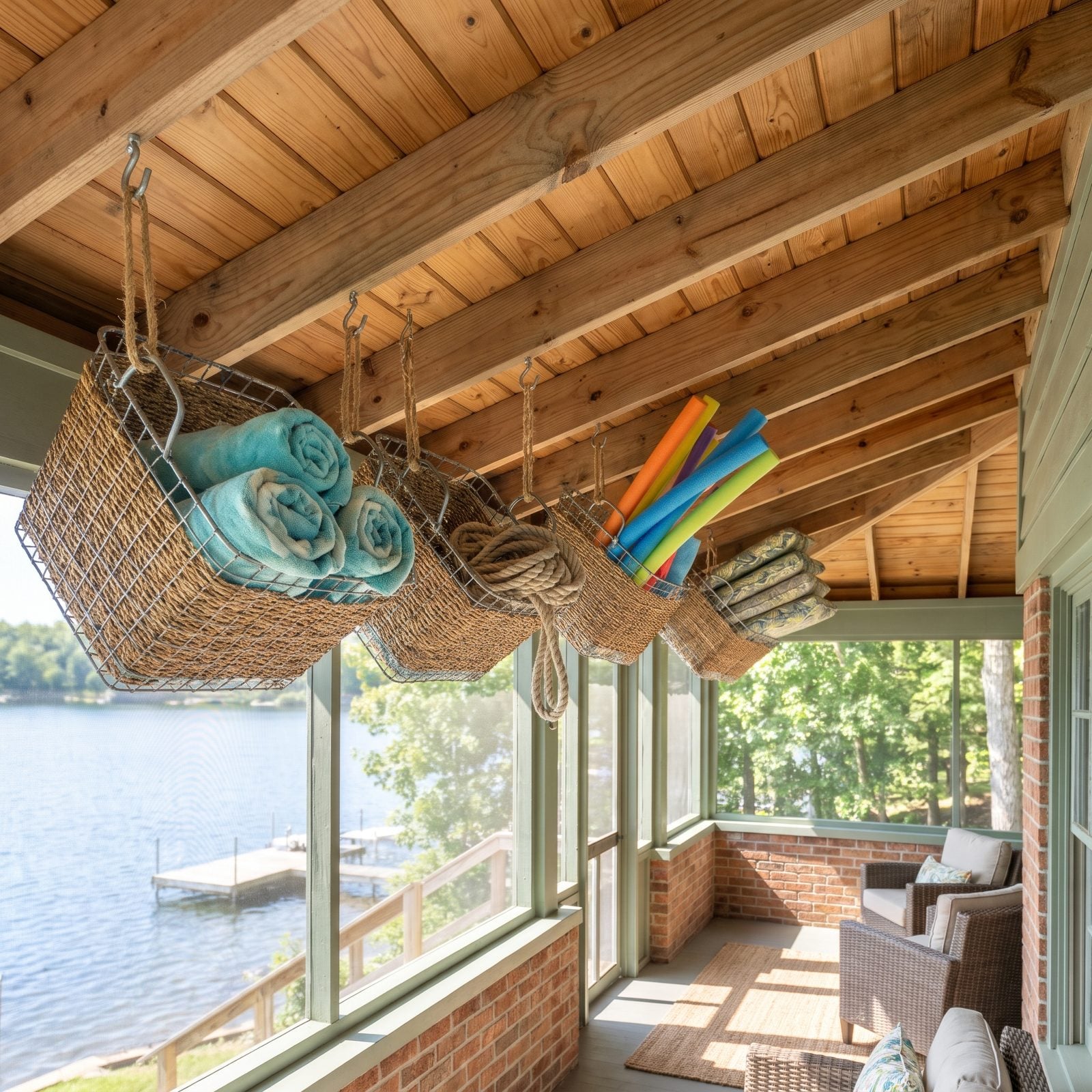
Look up on almost any covered porch and you’ll find dead space between the rafters. Open bays, perfectly sized, holding nothing but cobwebs and the occasional wasp nest.
Twist a sturdy screw hook into the underside of a rafter, hang a basket from it on loops of jute rope, and that bay becomes storage. Repeat down the line. It’s ideal for the porch odds and ends that need a home but not a closet: bug spray, citronella candles, a deck of cards, the flashlight for walking down to the dock after dark, a bag of badminton birdies.
Woven seagrass baskets set inside wire frames look right at home on a porch, but give them airflow. Porch air is damp, and seagrass that never fully dries can start to mildew up there where nobody’s looking, so leave space between baskets and take them down to air out now and then.
1. Keep Dock Toys in a Rolling Mesh Garden Cart
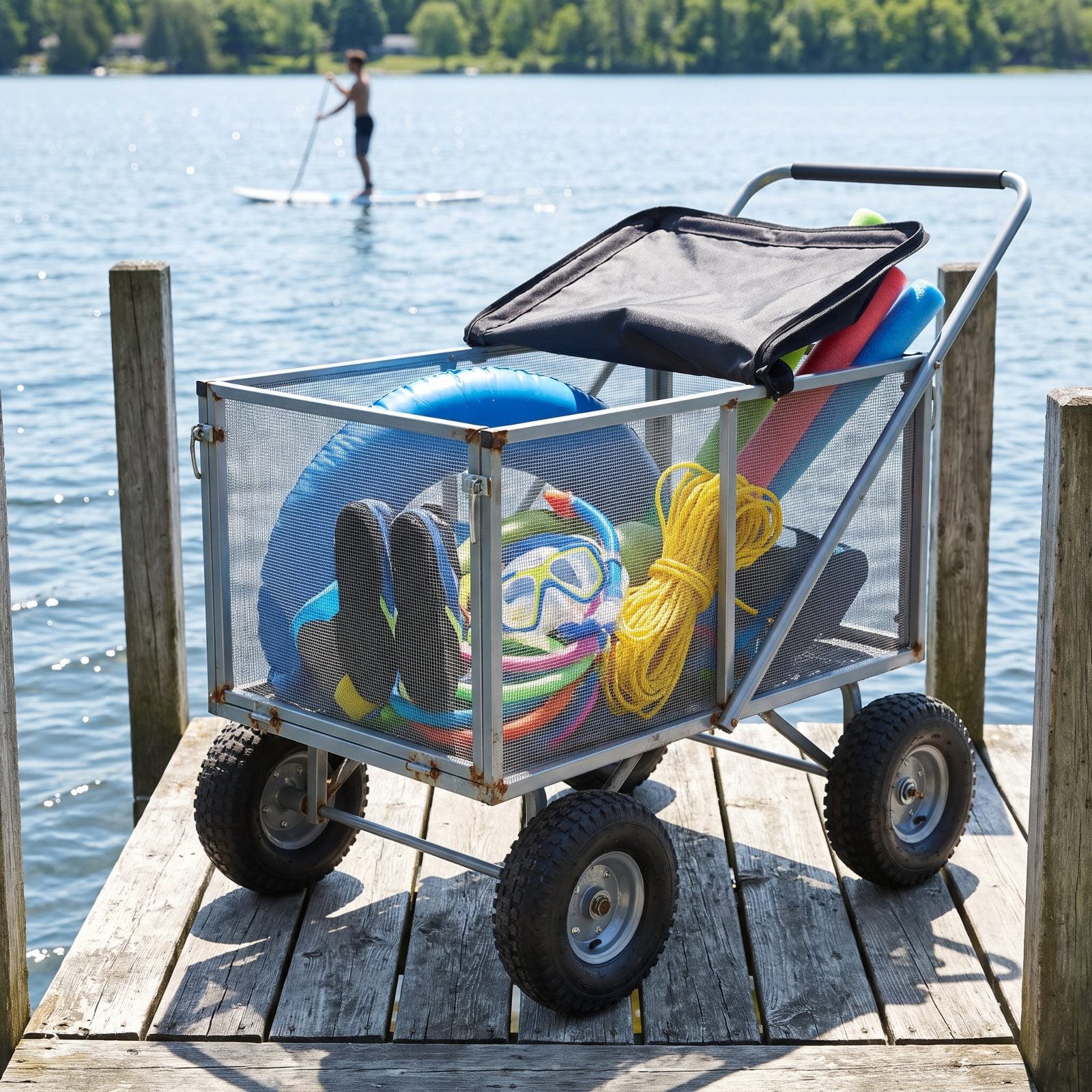
Dock toys multiply. Water guns, diving rings, foam balls, sand buckets, that one inflatable shark that never fully deflates. By August, the pile at the end of the dock is bigger than the boat.
A rolling garden cart with mesh sides solves two problems at once. Load everything in at the house, wheel it down to the water, and wheel it back up at sunset instead of making five trips with dripping arms. Between uses, the mesh lets water drain out and air move through, so toys dry in the cart instead of sitting in a puddle at the bottom of a plastic tub.
Look for a cart with big wheels if the path to the dock is grass, gravel, or sand. Park it in the sun after a swim, hose it out every so often, and the whole collection stays in one place all summer long.